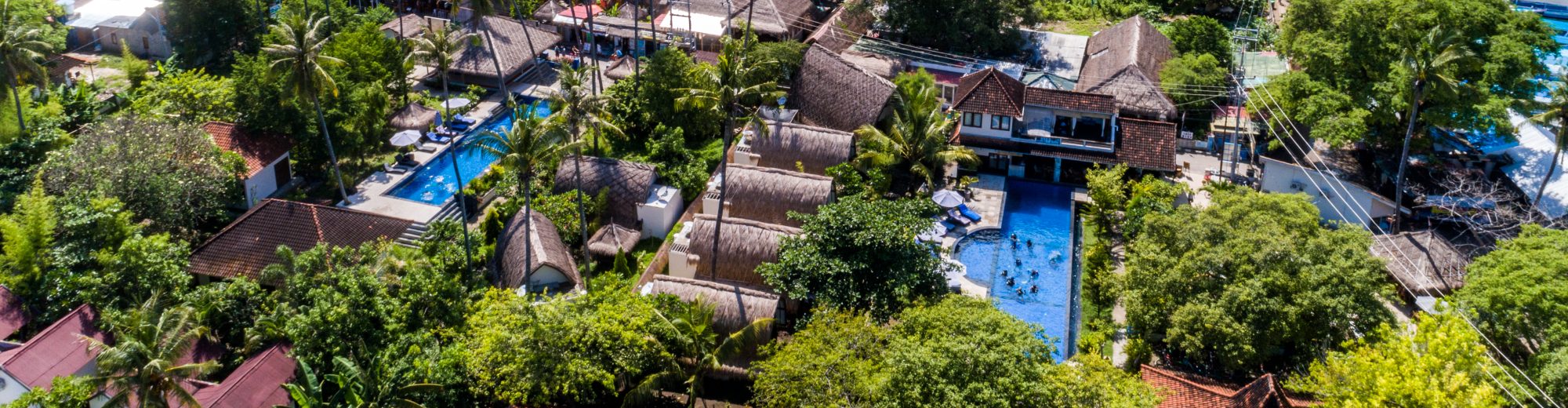

From a Small Fishing Community to an International Island Destination
Today, Gili Air is known around the world as a tropical holiday destination. Travellers come here to scuba dive, snorkel with turtles, relax on white-sand beaches, practice yoga and enjoy an island without conventional cars or motorbikes.
But Gili Air did not start as a tourist destination.
Long before dive centres, hotels, restaurants and beach bars appeared, life on the island was shaped by the sea, the land and one especially valuable resource: water.
The earliest communities were connected closely with Lombok and other parts of the Indonesian archipelago. Fishing, coconut cultivation, small-scale agriculture, livestock and trading were much more important than tourism.
Understanding this history is important because modern Gili Air did not simply appear when foreign travellers discovered it. The island already had its own community, traditions and relationship with the ocean.
Where Is Gili Air?
Gili Air is the easternmost of the three well-known Gili Islands: Gili Trawangan, Gili Meno and Gili Air. The islands lie off the northwest coast of Lombok in West Nusa Tenggara, Indonesia.
The word “gili” means small island in the Sasak language used on Lombok. There are therefore many islands around Lombok whose names contain the word Gili.
Gili Air is the closest of the three islands to mainland Lombok.
That geographical position played an important role in its development.
For people travelling by traditional boat, the relatively short crossing from Lombok made Gili Air accessible for fishing, collecting resources, trading and eventually permanent settlement.
Who Were the First People of Gili Air?
The earliest history of Gili Air is not documented in the same way as the history of a large Indonesian town or city.
There is no single historical record telling us that one particular person arrived on one particular date and founded Gili Air.
Much of the island’s early story has therefore been passed down through oral history and has to be understood within the wider history of Lombok and eastern Indonesia.
The population of the Gili Islands has historically been associated particularly with Sasak communities from Lombok, together with connections to Bugis and other maritime communities from elsewhere in Indonesia.[1]
This makes sense geographically.
The Sasak are the majority ethnic group on Lombok, only a short boat ride away. Fishing families could travel between the mainland and the islands relatively easily.
Bugis communities also have a long maritime tradition throughout Indonesia. Bugis sailors, fishermen and traders travelled widely across the Indonesian archipelago and established communities far from their original homeland in South Sulawesi.
The early population of Gili Air should therefore not be seen as one isolated group.
Like many small Indonesian islands, the community developed through migration, fishing, trade, marriage and movement between islands.
Why Did People Stay on Gili Air?
To understand why people stayed permanently on Gili Air, we have to imagine the island before tourism.
There were no luxury villas.
There were no dive centres.
There were no international restaurants.
There were no fast boats carrying hundreds of tourists every day.
People needed very basic things to survive: food, shelter and, most importantly, water.
This is where Gili Air had an important advantage.
The island was known for having accessible groundwater. For fishermen and families travelling between Lombok and the small offshore islands, the possibility of obtaining relatively fresh water made Gili Air more suitable for permanent settlement.
This connection with water is also traditionally associated with the island’s name.
In the Sasak language, “gili” means small island, while in Bahasa Indonesia “air” means water.
Gili Air can therefore be understood as “Water Island.”
For people considering permanent life on a small tropical island, access to water was essential.
Excellent fishing grounds were useful, but fishing alone was not enough to create a permanent settlement. Families needed water for drinking, cooking, washing, livestock and agriculture.
Gili Air had groundwater that could be reached through wells.
This water should not necessarily be compared with modern bottled drinking water. Groundwater on small coral islands can contain minerals and some salt, and saltwater intrusion is an ongoing issue.
However, historically, the availability of relatively fresh groundwater made an enormous difference.
Instead of fishermen only travelling to the island temporarily and then returning to Lombok, people could stay.
And staying changed everything.
Water, Fishing and Proximity to Lombok
Gili Air offered a valuable combination of three things: water, productive fishing grounds and proximity to Lombok.
The island lies closer to mainland Lombok than either Gili Meno or Gili Trawangan.
For Sasak fishermen and families from the northwest coast of Lombok, the crossing was manageable using traditional boats.
The surrounding seas provided fish.
The island provided land where people could grow coconuts, keep animals and establish homes.
And the groundwater provided the resource that made more permanent life possible.
Over time, temporary use became settlement.
Settlement became community.
And Gili Air became home.
This may also help explain why Gili Air developed as a more established local community compared with the other two islands.
Even today, the name of the island reminds us of one of the most basic reasons people could live here.
Water.
Life as a Fishing Community
For generations, the ocean was effectively Gili Air’s workplace.
Fishing was not a tourist attraction.
It was food, income and survival.
Fishermen depended on their knowledge of currents, seasons, weather, reefs and fish behaviour.
This knowledge was not learned through apps or online weather reports. It was passed from one generation to another.
Traditional boats were essential.
They allowed fishermen to reach different fishing grounds, but they also connected Gili Air with Lombok.
Supplies could be brought to the island, while fish, coconuts and other products could be transported to markets on the mainland.
This is something easily forgotten today.
The people of Gili Air had an economic relationship with the ocean long before tourists came here to snorkel or scuba dive.
Farming and Coconut Cultivation
Fishing was important, but it was not the only activity.
Older Gili Air looked very different from the island visitors see today.
Large parts of the interior were covered with coconut palms and relatively open land.
Families grew coconuts, maintained small gardens and kept livestock.
Before hotels and villas occupied much of the island, the landscape was much more rural.
Coconuts were especially valuable.
They could be consumed locally, traded or sold, and coconut trees became an important part of the traditional landscape throughout Lombok and the Gili Islands.
The combination of fishing, farming, livestock and trade allowed families to survive without tourism.
Life was simpler, but also physically demanding.
Everything depended on local resources and boat connections with Lombok.
A Quiet Island Before Tourism
For most of its history, Gili Air was certainly not internationally famous.
There was no airport bringing international travellers directly to Lombok.
There were no daily fast boats from Bali.
There were no online booking platforms.
There was no Instagram.
Life revolved around the local community.
People knew their neighbours.
Fishing families were connected to one another.
Lombok remained economically, culturally and socially important.
Visitors looking at Gili Air today can find it difficult to imagine just how limited development once was.
Electricity, fresh water distribution, communications, accommodation and transportation were all very different from today.
Then travellers started discovering Lombok and the Gili Islands.
When Did Tourism Start on Gili Air?
Tourism around Lombok and the Gili Islands began developing significantly during the 1970s and especially the 1980s and 1990s.
The earliest international visitors were generally not luxury travellers.
Many were backpackers.
Indonesia was becoming an important part of the Southeast Asian backpacking route.
Bali was already internationally famous, and more adventurous travellers began moving eastwards toward Lombok.
The Gili Islands offered something very different.
There were beautiful beaches, clear water, coral reefs, cheap accommodation and a relaxed village atmosphere.
Early accommodation was simple.
Instead of swimming pools, air-conditioned villas and boutique resorts, visitors stayed in basic locally operated bungalows and homestays.
Tourism grew gradually.
Gili Trawangan developed a strong backpacker and nightlife reputation.
Gili Meno became known as the quietest of the three.
Gili Air developed its own identity somewhere between the two.
It maintained a strong local population while also becoming increasingly popular with tourists.
Lombok itself has been part of the international backpacking route since at least the 1980s, with tourism expanding substantially afterwards.[3]
Scuba Diving Changes the Islands
One of the biggest transformations came with scuba diving.
The same reefs that had supported fishing families also proved extremely attractive to recreational divers.
Warm tropical water, turtles, sharks, coral reefs and relatively short boat rides between dive sites made the Gili Islands an excellent diving destination.
Dive centres started to appear and gradually became a major part of the islands’ economies.
This created an entirely new form of employment.
A young person growing up on Gili Air or Lombok no longer necessarily had to become a fisherman.
He or she could become a boat crew member, compressor operator, divemaster, dive instructor, hotel employee, restaurant worker or tourism entrepreneur.
The sea was still providing income.
But the economic model had changed.
Instead of catching a fish and selling it once, tourism created value from keeping marine life alive and allowing thousands of visitors to see it.
That transformation would eventually become closely linked with conservation.
The Creation of the Gili Matra Protected Area
As tourism increased, so did awareness that the marine environment required protection.
In 1993, the waters surrounding Gili Air, Gili Meno and Gili Trawangan received formal protected-area status through Indonesian government regulation.[4]
The conservation area eventually became what is now known as the Gili Matra Marine Conservation Area.
Management responsibilities later developed under the Ministry of Marine Affairs and Fisheries, with BKKPN Kupang involved in managing the area.[4]
This represented an important change.
The reefs were no longer seen only as fishing grounds or tourism attractions.
They were formally recognized as ecosystems requiring protection and management.
Today, the Gili Matra area contains important coral reef and seagrass habitats and supports species such as sea turtles, reef sharks and many other marine animals.[5]
Tourism Becomes the Main Economy
During the 2000s and 2010s, development accelerated dramatically.
More dive centres opened.
Simple bungalows became resorts.
Restaurants became more sophisticated.
Internet access improved.
Fast boats connected the islands directly with Bali.
Online booking platforms allowed someone sitting in Amsterdam, London, Sydney or New York to reserve accommodation on Gili Air within minutes.
Land that had once had relatively little commercial value became extremely valuable.
For many local families, this created enormous opportunities.
Families opened homestays, restaurants, shops, transport businesses and tourism services.
Others rented or sold land to Indonesian or foreign investors.
Within only a few generations, the economic structure of Gili Air had changed completely.
Are There Still Fishing Families on Gili Air?
Yes.
This is an important part of the island’s story.
Fishing has not completely disappeared.
There are still families on Gili Air with strong fishing traditions, and some residents continue to fish.
Boats and fishing remain part of local island life.
But fishing no longer holds the dominant economic position it once did.
Tourism has created many other options.
A son or daughter of a fisherman may choose to become a divemaster.
Another family member may work in a hotel.
Someone else may own a restaurant, operate a boat, work in construction or rent rooms to tourists.
The fishing families did not necessarily disappear.
Their occupations changed.
This distinction is important.
When visitors meet a divemaster, boat captain, restaurant owner or hotel worker today, they may not realize that the person’s father or grandfather could have spent his life fishing the same waters where tourists now dive.
From Fishing to Conservation
One of the most interesting changes in Gili Air’s history is how the economic value of the reef has changed.
Originally, the reef was primarily viewed as a source of food and other resources.
Today, a healthy reef has enormous value precisely because it remains alive.
Healthy coral attracts divers and snorkellers.
Turtles attract visitors.
Sharks have become animals that divers travel thousands of kilometres to see.
Healthy seagrass and coral ecosystems support biodiversity, fisheries and tourism simultaneously.
This has encouraged cooperation between government agencies, local communities and tourism businesses.
The Indonesian Ministry of Marine Affairs and Fisheries has highlighted cooperation between communities and businesses in protecting biodiversity in Gili Matra.[2]
In 2024 and 2025, BKKPN Kupang and Oceans 5 Gili Air signed a conservation partnership involving ecosystem rehabilitation, biodiversity monitoring and community participation. Oceans 5 Gili Air became in 2021 the first Foreigner Investment Company (PMA) in Indonesia with a conservation status in her company papers.
The relationship between local people and the ocean therefore continues to evolve.
Gili Air Today
Modern Gili Air would be almost unrecognizable to someone who had known the island many decades ago.
International tourists now walk along paths that were once surrounded mainly by coconut trees and simple homes.
Dive boats leave every morning carrying divers from countries around the world.
Restaurants serve Indonesian, Italian, French, Mexican and many other cuisines.
Hotels can be booked online from the other side of the world.
Yet underneath this international tourism industry remains a local Indonesian island community.
That community is essential to Gili Air’s identity.
The island is not simply a holiday resort built for tourists.
It is a living community whose history existed long before tourism and whose families helped shape the island visitors enjoy today.
The Importance of Water Today
There is also an interesting connection between Gili Air’s past and its present.
Water may have been one of the reasons people were able to settle permanently on the island, but water remains one of the island’s biggest challenges today.
The population has grown.
Tourism has increased water demand dramatically.
Hotels, swimming pools, restaurants, gardens and thousands of visitors require much more water than the original fishing and farming community ever did.
At the same time, small islands have fragile groundwater systems.
Excessive groundwater extraction can increase saltwater intrusion, making wells increasingly salty.
This means the resource that may have helped create Gili Air’s first permanent community must still be managed carefully today.
The name Gili Air — Water Island — therefore remains remarkably relevant.
The Next Chapter of Gili Air’s History
The biggest historical question is now what happens next.
Gili Air has already experienced several major transformations.
It developed from a small island used by fishing and farming communities into a permanent settlement.
It later became a backpacker destination.
Then it developed into an internationally recognized tourism and diving destination.
The challenge now is ensuring that development does not destroy the very things that made Gili Air successful.
Coral reefs need protection.
Fresh water needs responsible management.
Waste needs to be controlled.
Construction needs to respect the limitations of a very small island.
And development needs to continue providing opportunities for the local community.
Gili Air’s history teaches us something important.
The island has always depended on its natural environment.
The fishermen depended on the sea.
The farmers depended on the land and groundwater.
Today’s divemasters, instructors, hotels, restaurants and tourism businesses depend on exactly the same environment.
The occupations may have changed.
The fundamental relationship has not.
Without a healthy island, a healthy ocean and responsible access to water, there can be no sustainable future for Gili Air.
Frequently Asked Questions About the History of Gili Air
1. Who were the original inhabitants of Gili Air?
The early population was strongly connected to Lombok, particularly Sasak communities, while the wider Gili Islands also have historical connections with Bugis and other Indonesian maritime communities.[1] Precise details of the earliest permanent settlement are difficult to establish because much of the island’s early history was passed down orally rather than recorded in detailed written documents.
2. Why did people originally settle on Gili Air?
One of the most important reasons was access to water. Gili Air was known for accessible groundwater, which made permanent settlement more practical. Combined with productive fishing grounds, land for coconuts and livestock, and its short distance from Lombok, this made Gili Air an attractive place for families to live rather than simply visit for fishing.
3. Is Gili Air named after water?
The name is commonly associated with water. “Gili” means small island in Sasak, while “air” means water in Bahasa Indonesia. Gili Air can therefore be understood as “Water Island.” Local explanations traditionally connect the name to the presence of groundwater, which was extremely important for permanent settlement.
4. Where did the people of Gili Air come from?
Many families have roots on mainland Lombok, particularly among Sasak communities. There are also historical connections with Bugis and other groups from elsewhere in Indonesia. Migration and intermarriage mean the island’s population should not be viewed as coming from one single group.
5. What did people do before tourism?
Fishing was extremely important, alongside coconut cultivation, small-scale farming, livestock, trading and boat transport. The economy depended much more directly on local natural resources than it does today.
6. When did tourists start visiting Gili Air?
Small numbers of adventurous travellers began discovering Lombok and the Gili Islands before mass tourism developed, with backpacker tourism becoming increasingly important from around the 1980s onwards.[3] Tourism expanded significantly during the 1990s, 2000s and 2010s.
7. When did scuba diving become important?
Scuba diving grew alongside tourism and eventually became one of the most important industries on the three Gili Islands. Warm water, turtles, coral reefs and numerous dive sites helped turn the islands into an internationally recognized diving destination.
8. Are there still fishermen on Gili Air?
Yes. Fishing has not disappeared, and there are still local families with strong fishing traditions. However, tourism now provides many alternative sources of employment, so younger generations may instead work as divemasters, boat captains, hotel employees, restaurant owners or in other tourism-related professions.
9. Is Gili Air inside a marine protected area?
Yes. Gili Air, Gili Meno and Gili Trawangan are surrounded by the Gili Matra Marine Conservation Area. Formal protected status dates back to 1993, although its designation and management structure have developed since then.[4]
10. Why is conservation so important to Gili Air?
Coral reefs, seagrass beds and marine animals support biodiversity, fisheries and tourism. The same ecosystem that once primarily supported fishermen now also supports dive centres, hotels, restaurants, boat operators and many tourism-related jobs.[2][5]
11. Has tourism been good or bad for Gili Air?
Tourism has created major economic opportunities, businesses and jobs for local families. At the same time, rapid development increases pressure on land, water, reefs and waste-management systems. The long-term challenge is balancing economic development with environmental protection and the interests of the local community.
12. Is freshwater still important on Gili Air today?
Yes. Water remains one of the island’s most important resources. Tourism has dramatically increased demand, while groundwater on small islands is vulnerable to saltwater intrusion. Responsible water management is therefore just as important for Gili Air’s future as access to water may have been for its earliest permanent residents.
References
[1] International Parks – Gili Matra, Indonesia: Human History. Historical overview discussing traditional use of the Gili Islands by Sasak and Bugis communities and their later development as tourism destinations.
[2] Ministry of Marine Affairs and Fisheries of the Republic of Indonesia (KKP), 2023 – Kolaborasi KKP-Masyarakat Jaga Keanekaragaman Hayati Gili Matra. Information on community livelihoods, biodiversity and collaboration between government, communities and tourism businesses in the Gili Matra area.
[3] Historical and tourism accounts of Lombok and the Gili Islands describing the growth of backpacker tourism during the 1980s and its expansion during subsequent decades.
[4] Government of Indonesia – Decree No. 85/Kpts-II/1993, dated 16 February 1993, concerning the protected status of the marine area surrounding Gili Air, Gili Meno and Gili Trawangan, together with subsequent management arrangements under the Ministry of Marine Affairs and Fisheries and BKKPN Kupang.