Tag Archives: vacation

Haven’t Dived for Six Months?

SSI Open Water Course Gili Islands | SSI Instructor Training Center Oceans 5 Gili Air

Why a Scuba Refresher Is Worth It

Your scuba certification does not expire.

Whether you completed your Open Water Diver course six months ago, six years ago or even longer, your certification card remains valid. But there is an important difference between being certified and being ready to dive comfortably.

Scuba diving involves knowledge, coordination and practical skills. You must remember how to assemble your equipment, control your buoyancy, clear your mask, recover your regulator, communicate with your buddy and respond calmly when something unexpected happens.

When these skills are not used regularly, they can become rusty. Confidence can also disappear faster than many divers expect. SSI therefore offers the Scuba Skills Update, a refresher program designed to help inactive divers review their knowledge and practise essential skills under the supervision of an SSI Professional [1].

At Oceans 5 Gili Air, we normally recommend a refresher when a diver has not been underwater for six months or longer. This is not a punishment, and it is not a judgment about your ability.

It is simply a comfortable and sensible way to return to diving.

Your Certification Does Not Expire—but Your Skills Can Fade

Many divers arrive at a dive center and immediately show their certification card.

“I’m an Advanced Diver.”

“I have completed 50 dives.”

“I have been diving for 20 years.”

All of that information is useful, but it does not tell us when the person last went diving.

A diver with 200 logged dives who has been inactive for five years may need more assistance than someone with 20 dives who was underwater last week. Experience matters, but recent experience matters too.

Divers Alert Network warns that an extended break from diving can increase risk when divers presume that their previous experience means they are still fully prepared. DAN also notes that unfamiliar equipment can add to that risk [2].

Your certification proves that you demonstrated the required knowledge and skills when you completed your course. It does not guarantee that every skill will remain automatic forever.

This is normal. Skills fade when we do not practise them.

What Do Divers Commonly Forget?

Most returning divers do not forget everything. They usually remember the basic idea of diving, but smaller details may become less clear.

A diver may hesitate while assembling the regulator and BCD. They may forget which button adds air to the BCD or feel uncertain about releasing air while descending. Hand signals that once felt obvious may suddenly require more thought.

Common areas in which returning divers may need additional practice include:

  • Assembling and checking scuba equipment
  • Completing a proper pre-dive safety check
  • Using the low-pressure inflator and BCD dump valves
  • Establishing the correct amount of weight
  • Controlling descents and ascents
  • Clearing a partially or fully flooded mask
  • Recovering and clearing a regulator
  • Using an alternate air source
  • Monitoring depth, dive time and remaining gas
  • Communicating with a buddy
  • Maintaining neutral buoyancy
  • Deploying a surface marker buoy
  • Responding calmly to minor problems

These skills may return quickly. Sometimes a diver only needs a few minutes in the pool before everything begins to feel familiar again.

However, discovering what you have forgotten in a swimming pool is much better than discovering it at 18 metres while drifting in a current.

Why Does Oceans 5 Use Six Months as a Guideline?

There is no single interval that perfectly describes every diver.

Some people complete 100 dives and remain relaxed after a long break. Others complete their Open Water course during a holiday, make no additional dives and return one year later with very limited independent experience.

At Oceans 5 Gili Air, we use six months as a practical guideline. If your last dive was six months ago or longer, we will normally recommend completing a refresher before joining a regular fun dive.

This gives us an opportunity to assess your comfort, review the most important procedures and help you regain control in a calm environment.

The decision is not based only on the date of your last dive. We may also consider:

  • Your certification level
  • Your total number of dives
  • Your experience after certification
  • The conditions in which you previously dived
  • Your familiarity with the equipment
  • Your comfort and confidence
  • Your health and physical condition
  • The planned dive site and expected conditions

A diver with limited experience may benefit from a refresher even after a shorter break. An experienced diver returning after a long absence may remember everything quickly but still appreciate time to become familiar with rental equipment.

The six-month guideline starts the conversation. It does not replace individual assessment.

Diving Around the Gili Islands Can Involve Currents

The Gili Islands offer warm water, turtles, reef sharks, colourful reefs and fascinating macro life. Conditions can be excellent for both new and experienced divers.

However, currents are also part of diving around Gili Air, Gili Meno and Gili Trawangan. Depending on the tide, weather and location, currents can change in direction and strength.

A diver entering moving water must already feel comfortable with basic diving procedures. The ocean is not the ideal place to remember how to release air from a BCD, establish neutral buoyancy or communicate that something is wrong.

The current itself may not be the problem. The combination of current, unfamiliar equipment, poor buoyancy and low confidence can increase stress.

Diver stress can have physical, psychological, equipment-related and environmental causes. A lack of recent experience may also contribute to stress underwater [3]. A refresher removes several of these uncertainties before the actual dive begins.

A Refresher Is Not About Passing or Failing

Some divers feel embarrassed when we suggest a refresher.

They may think it means they are no longer a good diver. Others worry that they will be tested or that they may fail.

That is not how we see it.

A refresher is not an examination. It is a chance to practise. The objective is to identify what you still remember, what needs a little attention and what will help you feel comfortable again.

SSI’s Scuba Skills Update has no fixed course duration. This allows the SSI Professional to focus on the areas that matter to the individual diver rather than forcing everyone through exactly the same experience [1].

One diver may need more help with equipment assembly. Another may be perfectly comfortable with the equipment but struggle with mask clearing. Someone else may remember all the safety skills but need time to restore neutral buoyancy.

The program should respond to the diver—not the other way around.

Why Practise in a Swimming Pool First?

A controlled pool environment removes many of the variables found in the ocean.

There is no current carrying you away. There is no need to descend immediately because other divers are waiting. There is no reef below you, and you are not trying to follow a guide while simultaneously remembering how your equipment works.

At Oceans 5 Gili Air, we have two purpose-built training pools. This gives returning divers the space and time to become comfortable without feeling rushed.

In the pool, you can:

  • Adjust your equipment
  • Check whether the selected weight is appropriate
  • Practise breathing slowly and continuously
  • Review essential safety skills
  • Work on your body position
  • Restore control over your buoyancy
  • Ask questions
  • Repeat a skill when necessary

A skill does not always return perfectly on the first attempt. That is why we practise.

Neutral Buoyancy Should Be Part of the Refresher

At Oceans 5, we believe that neutral buoyancy is one of the most important skills for every diver.

Buoyancy affects comfort, breathing, gas consumption, control and environmental impact. A diver who cannot maintain position may make uncontrolled ascents or descents, kick the reef, disturb sediment or hold onto coral.

SSI encourages divers to practise applicable skills in a normal diving position while working toward neutral buoyancy [4]. At Oceans 5, this principle is central to how we teach.

A refresher should not simply demonstrate that you can kneel on the bottom and clear your mask. It should help prepare you for the position in which you will actually dive.

We therefore want returning divers to regain control while neutrally buoyant. This makes the transition from the pool to the ocean more realistic and helps protect the reefs inside the Gili Matra Marine Tourism Park.

Emergency Skills Need Practice Too

Most dives are relaxing and uneventful. Nevertheless, divers must be able to respond correctly when a problem occurs.

You may need to recover a regulator, clear water from your mask, signal that you are low on gas or assist a buddy with an alternate air source.

These actions are simple when they are familiar. They can become much more difficult when the diver has not practised them for years.

DAN recommends regularly reviewing essential skills such as regulator clearing and air sharing, especially when using unfamiliar equipment or diving with a buddy whose equipment configuration is different [5].

The purpose of practising emergency skills is not to make diving feel dangerous. It is to make the correct response more familiar so that a small problem remains a small problem.

Unfamiliar Rental Equipment Is Another Reason to Refresh

Even experienced divers can feel uncomfortable when using unfamiliar equipment.

BCD designs differ. Inflator and dump-valve positions can vary. Weight systems may be integrated into the BCD or attached to a belt. Alternate air sources may be configured differently. Dive computers use different buttons, displays and alarms.

If you normally dive with your own equipment but travel without it, the first dive of your holiday may involve an entirely new setup.

A refresher gives you time to locate and operate everything before entering the ocean. You can practise releasing weights, finding your alternate air source and using every BCD exhaust valve.

Being certified to dive does not automatically mean being familiar with every equipment configuration.

Honest Divers Are Safer Divers

There is no prize for pretending to remember something.

Dive professionals need accurate information to organize a safe and enjoyable dive. If we ask when you last dived, we are not trying to catch you out. We are trying to understand what assistance you may need.

Be honest about:

  • The date of your last dive
  • Your total number of dives
  • Any previous problems
  • Your comfort with currents
  • Your buoyancy control
  • Your air consumption
  • Medical changes since your last dive
  • Anything that makes you nervous

A good dive center will use this information to support you, select an appropriate site and place you in the right group.

Hiding a five-year break because you are worried about being asked to complete a refresher does not help you, your buddy, your guide or the other people in your group.

A Refresher Can Improve Your Entire Diving Holiday

Some divers see a refresher as losing part of their holiday.

We see it differently.

Spending time rebuilding your skills at the beginning can improve every dive that follows. Instead of worrying about your mask, equipment or buoyancy, you can focus on the reason you came to the Gili Islands:

  • Watching turtles swim over the reef
  • Looking for reef sharks
  • Finding nudibranchs and other macro life
  • Exploring different dive sites
  • Improving your underwater photography
  • Relaxing and enjoying the ocean

SSI describes the Scuba Skills Update as a useful program to complete before a dive holiday, allowing divers to spend less time worrying about their abilities and more time enjoying the underwater environment [1].

That is exactly the point.

Do Not Wait Until You Are on the Boat

If you know that you have not dived recently, tell the dive center before your first scheduled dive.

This allows time to organize a professional, equipment and suitable pool space. It also prevents an uncomfortable situation in which a problem is discovered just before the boat leaves.

Before booking, provide the dive center with:

  • Your certification agency and level
  • The approximate date of your last dive
  • Your number of logged dives
  • Whether you have your own equipment
  • Any concerns you have about returning

Planning the refresher in advance creates a much more relaxed start to your diving holiday.

There Is No Shame in Refreshing Your Skills

Responsible divers understand their limits.

Completing a refresher does not make you less experienced. In fact, choosing to practise after a period of inactivity shows good judgment.

Even instructors and Divemasters need to practise skills. Professional status does not make anyone immune to skill deterioration. The longer we spend away from a particular procedure, the less automatic it may become.

Diving should never become a competition over who can claim to need the least assistance.

The best diver is not the person with the highest certification card or the biggest number in a logbook. It is the person who remains aware, controlled, considerate and willing to continue learning.

Return to Diving with Confidence at Oceans 5 Gili Air

At Oceans 5 Gili Air, we want your first dive after a break to be enjoyable—not stressful.

Our refresher sessions give you time to become familiar with the equipment, review important procedures and restore your neutral buoyancy in one of our training pools before returning to the ocean.

We keep our groups small and match divers according to their certification, experience and comfort. Once you are ready, you can enjoy diving around Gili Air, Gili Meno and Gili Trawangan with much greater confidence.

If it has been six months or longer since your last dive, let us know when you make your booking.

Your certification may not expire.

But confidence and practical skills deserve regular attention.

A short refresher could make the difference between spending your first dive trying to remember what to do and spending it enjoying everything the Gili Islands have to offer.


Frequently Asked Questions

Does my scuba certification expire?

No. Recreational scuba certifications generally do not have an expiry date. However, a valid certification card does not guarantee that your knowledge, skills and confidence are still current. A dive center may recommend or require a refresher based on your inactivity, experience and the planned diving conditions.

Do I need a refresher if I have not dived for six months?

At Oceans 5 Gili Air, we normally recommend a refresher when you have not dived for six months or longer. Six months is a practical guideline rather than a claim that every diver loses their ability after exactly six months. Your total experience, certification level, confidence and planned dive conditions will also be considered.

What is the SSI refresher program called?

The official SSI program is called the Scuba Skills Update. It allows divers to review and practise the knowledge and skills learned during their original training under the guidance of an SSI Professional [1].

What skills are included in a scuba refresher?

The exact content can be adapted to the diver, but it may include equipment assembly, the pre-dive safety check, mask clearing, regulator recovery, alternate-air-source use, buoyancy control, controlled ascents and descents, hand signals and gas monitoring.

Can I fail a scuba refresher?

A refresher is designed as a practice and update session rather than a competitive examination. However, the dive professional must be satisfied that you can participate safely before taking you on an open-water dive. If you need more practice, additional time or training may be recommended.

Why can’t I refresh my skills during the first ocean dive?

The ocean adds depth, current, waves, boat activity and environmental considerations. A swimming pool provides a more controlled setting in which you can concentrate on your skills without unnecessary pressure. It is better to resolve problems before entering open water.

Do experienced divers need refreshers?

Yes, experienced divers can also benefit from refreshers. A high number of logged dives does not prevent skills from becoming rusty after a long period of inactivity. DAN notes that extended breaks and presumptions about previous ability can increase risk [2].

Should I complete a refresher before travelling?

When possible, you can complete a refresher with a qualified dive professional before your holiday. Alternatively, you can schedule it at your destination. Completing it at Oceans 5 has the additional advantage of allowing you to become familiar with the equipment you will use during your dives.

Can I complete a refresher if I was certified by another agency?

Normally, yes. Divers certified by recognized training agencies can generally complete an SSI Scuba Skills Update. Contact Oceans 5 before booking and provide the details of your certification and diving experience so we can confirm the appropriate program.

What if I have not dived for several years?

Tell us how long you have been inactive and how much experience you had before your break. A Scuba Skills Update may be sufficient, but after a very long absence or with limited previous experience, more extensive retraining may be the better option.

Will I practise neutral buoyancy?

Yes. At Oceans 5, neutral buoyancy is an essential part of diver training. We want you to regain control in a realistic diving position rather than completing every exercise while kneeling on the bottom.

Is a medical check necessary before returning to diving?

You should review the current diver medical questionnaire, particularly if your health, medication or physical condition has changed since your last dive. A “yes” answer may mean that written clearance from an appropriate medical professional is required before diving. Never hide a medical change from the dive center.


References

[1] Scuba Schools International (SSI) – Scuba Skills Update. Official information about SSI’s refresher program, including its purpose, format and focus on restoring knowledge, practical skills and confidence.

[2] Divers Alert Network – The Effect of Experience on Risk. Discussion of diving experience, extended periods of inactivity, refresher training and the additional challenges created by unfamiliar equipment.

[3] Scuba Schools International (SSI) – Diver Stress and Rescue educational materials. Information about physical, psychological, equipment-related and environmental sources of diver stress and the role of experience in managing problems underwater.

[4] Scuba Schools International – In-Water Training Philosophy. SSI guidance encouraging the practice of applicable skills in a normal diving position while developing neutral buoyancy.

[5] Divers Alert Network – Never Too Experienced to Refresh Skills. A diving incident analysis emphasizing the importance of regularly practising essential skills, including regulator clearing and alternate-air-source use.

Neutral Buoyancy Is Marine Conservation

Marine Conservation

Marine conservation has become an important part of the identity of many dive centers. We talk about protecting coral reefs, reducing plastic, organizing beach clean-ups, restoring damaged reefs, monitoring marine life and educating divers about the underwater environment.

These are all valuable efforts.

But there is a much more basic question every dive center claiming to have a conservation philosophy should ask:

How good is the buoyancy of the divers and dive professionals you put into the ocean every day?

Recreational scuba diving can have direct physical impacts on coral reefs, particularly through contact by fins, hands, knees and equipment. Research has shown that diver contacts can damage living coral and that diver behaviour and environmental awareness play an important role in reducing these impacts [1–3].

Because conservation does not start with a coral restoration project.

It starts with how we dive.

At Oceans 5 Gili Air, we believe that neutral buoyancy is marine conservation. That philosophy influences how we teach beginner divers, how our Divemasters guide certified divers, how our instructors behave underwater and how we train the next generation of dive professionals.

You cannot tell people to protect the reef while demonstrating diving techniques that unnecessarily put you in contact with it.

Conservation Starts With Your Own Fins

It is easy to call yourself environmentally friendly.

A dive center can organize a beach clean-up. It can participate in a coral restoration project. It can put conservation signs around the dive center. It can post photographs of turtles, sharks and healthy reefs on social media.

But what happens when its divers enter the water?

Studies of recreational diving have documented contacts between divers and coral reefs, with fins frequently responsible for accidental contact [1,2]. Research has also shown that intervention, education and active management can significantly reduce damaging diver behaviour [3,4].

A diver with poor buoyancy can accidentally kick coral, stir up sediment, crash into the reef, grab something for stability or kneel on the bottom.

A single mistake doesn’t make someone a bad diver. Beginners are learning, and learning requires patience.

The important question is:

What are we teaching them?

If poor buoyancy becomes accepted as normal, we create divers who believe contact with the underwater environment is simply part of diving.

We don’t believe it should be.

Neutral Buoyancy Should Not Be an Advanced Skill

There is sometimes a strange contradiction in scuba education.

We tell new divers:

Don’t touch the reef.

Then we take them underwater, place them on the bottom and ask them to perform skills.

What message are we actually giving them?

A student learns not only from what an instructor says. A student also learns by observing the instructor. Behavioural research has long demonstrated the importance of observational learning: people can acquire behaviours by watching others [5].

That principle matters underwater too.

If an instructor routinely kneels on the bottom, students can begin to see kneeling underwater as normal.

If a Divemaster lies on the seabed while looking at a shark, guests may assume that this is acceptable diving behaviour.

If an instructor grabs the reef to remain in position, how can we expect students to understand why they shouldn’t do exactly the same thing?

That is why Oceans 5 takes a different approach.

Neutral buoyancy is not something we save for later.

It is part of learning to dive.

At Oceans 5, Ocean Skills Are Taught Neutrally Buoyant

During training at Oceans 5 Gili Air, our philosophy is simple:

When we enter the ocean, we are divers—not people sitting on the bottom wearing scuba equipment.

Our students therefore perform their underwater skills while neutrally buoyant whenever appropriate to the training standard.

Regulator recovery, mask skills, air-sharing exercises, buoyancy exercises, out-of-air procedures and other underwater skills are practiced with the objective of maintaining control.

The objective isn’t only to complete a skill successfully.

The student should learn to perform it while maintaining control of their body, depth and position in the water.

That makes the exercise more realistic.

In a real diving situation, there probably isn’t a convenient sandy platform underneath you.

A diver should be able to deal with a problem while diving.

No Touching Means No Touching

Oceans 5 operates around the Gili Islands within the Gili Matra Marine Protected Area.

For us, a no-touching philosophy isn’t something that applies only when we happen to be swimming over beautiful coral.

It is a diving philosophy.

Don’t stand on the reef.

Don’t kneel unnecessarily on the seabed.

Don’t hold coral to take a photograph.

Don’t grab something because there is current.

Don’t lie on the bottom to watch a shark.

Don’t chase a turtle.

Don’t move an animal because it would make a better photograph.

Corals are living organisms, and physical contact can cause breakage, tissue damage and other disturbances. The cumulative impact becomes particularly important at frequently visited dive sites where many individual contacts can occur over time [1,2,6].

And importantly:

Dive professionals should lead by example.

There may always be situations in which contact is necessary for safety, an emergency or a specific authorized activity. Safety comes first. But unnecessary contact should never become standard diving behaviour.

Dive Professionals Are Ocean Ambassadors

A Divemaster or instructor has much more influence underwater than they sometimes realize.

Guests watch us.

Students copy us.

If the guide gets extremely close to a turtle, the group follows.

If the Divemaster lies on the bottom, guests may lie beside them.

If the instructor touches the reef, the student quickly learns that “don’t touch” apparently has exceptions.

But the opposite is also true.

When a dive professional demonstrates excellent buoyancy, maintains an appropriate distance from marine animals and moves calmly through the environment without touching anything, guests notice that too.

Professional behaviour can create responsible behaviour.

Research into diver impacts supports the importance of briefings, environmental education and direct intervention in reducing contacts with coral reefs [3,4].

That is why we see our dive professionals as ocean ambassadors.

Being an ocean ambassador isn’t a title for social media.

It is behaviour that should be visible on every dive.

Your Fins Can Undo Your Conservation Message

Imagine spending hours restoring a damaged reef and then taking poorly controlled divers across another part of that reef every day.

Imagine teaching people about coral conservation while your instructors routinely kneel underwater.

Imagine telling guests not to disturb marine animals while the guide lies on the bottom to get closer to a shark.

There is a contradiction.

Conservation cannot be something we switch on during a conservation activity and switch off during a normal fun dive.

Every dive is a conservation dive when you dive responsibly.

And every dive can have a negative impact when you don’t.

Research on heavily visited coral reefs demonstrates why cumulative tourism pressure deserves attention. Individual contacts may appear insignificant, but repeated interactions across large numbers of divers can create measurable impacts [1,2,6].

Perfect Buoyancy Is Not About Looking Good

Sometimes excellent buoyancy is presented almost as a performance.

A perfectly horizontal diver makes a great photograph.

But trim and buoyancy aren’t primarily about looking professional.

They give a diver control.

With good buoyancy and trim, you can stop without grabbing something. You can observe a small animal without landing beside it. You can swim above coral without kicking it. You can maintain your position while taking a photograph. You can respond to another diver without immediately sinking toward the bottom.

Most importantly, you become aware of where your entire body is underwater—including your fins.

That is conservation in practice.

This Is Why Instructor Training Matters

The philosophy becomes even more important when training instructors.

An instructor doesn’t influence only the students standing in front of them today.

That instructor may teach hundreds or even thousands of divers during their career.

Poor habits multiply.

But good habits multiply too.

This is one reason why the SSI Instructor Training Courses at Oceans 5 Gili Air place so much emphasis on realistic teaching techniques, buoyancy, trim and control.

We want instructor candidates to be comfortable teaching while neutrally buoyant because that is the environment in which their future students will actually dive.

If we want future divers to protect the ocean, we first need instructors capable of demonstrating what responsible diving looks like.

Conservation Cannot End When the Beach Clean-Up Ends

Picking up plastic is conservation.

Monitoring reefs is conservation.

Studying changes in marine ecosystems is conservation.

Supporting marine research is conservation.

Educating local students is conservation.

Reef restoration is conservation.

But so is hovering 50 centimeters above the reef without touching it.

Sometimes the simplest conservation action is simply leaving the underwater environment exactly as you found it.

That requires skills.

The United Nations Environment Programme and other conservation organizations have repeatedly highlighted the pressures tourism can place on coral reef ecosystems and the importance of sustainable tourism practices in reducing those impacts [7].

For dive centers, sustainable tourism therefore shouldn’t only be about what happens on land.

It should be visible underwater.

Before Calling Yourself a Conservation Dive Center, Look Underwater

Maybe the diving industry needs to ask itself a difficult question:

Is it enough to have a conservation philosophy if our everyday diving behaviour doesn’t support it?

A conservation logo doesn’t protect coral.

An Instagram post doesn’t protect coral.

A beach clean-up doesn’t compensate for poor diving practices.

And a no-touching policy means very little when the professionals themselves cannot maintain their position without touching the bottom.

Conservation should be visible in the way we operate every single day.

For Oceans 5 Gili Air, that means starting with something every diver can control:

ourselves.

Neutral Buoyancy Is Marine Conservation

We don’t expect a new diver to have perfect buoyancy immediately.

Learning takes time.

Mistakes happen.

That is why instructors exist.

Our responsibility isn’t to criticize beginners for not already possessing a skill they came to us to learn.

Our responsibility is to teach them properly from the beginning.

Teach them that the bottom isn’t a chair.

Teach them that coral isn’t a handhold.

Teach them that marine animals don’t need to move for their photograph.

Teach them that being a good diver means being in control.

And most importantly, demonstrate those principles ourselves.

Because protecting the ocean isn’t only about the conservation projects we organize.

It is about what happens during the thousands of ordinary dives taking place around our reefs every year.

Control your buoyancy. Control your fins. Respect the animals. Don’t touch the reef.

That is not separate from marine conservation.

That is marine conservation.

FAQ

Why is neutral buoyancy important for marine conservation?

Neutral buoyancy allows divers to maintain their position without standing, kneeling, grabbing or crashing into the underwater environment. Studies examining diver impacts have identified physical contact, particularly fin contact, as an important source of recreational diving pressure on coral reefs [1–3].

Should beginner divers be expected to have perfect buoyancy?

No. Beginners are learning, and mistakes will happen. The responsibility of the instructor is to create an environment in which students progressively develop buoyancy and body control instead of becoming dependent on the bottom.

Why does Oceans 5 teach skills neutrally buoyant in the ocean?

Because this is how divers actually dive. Performing skills while neutrally buoyant combines problem-solving with depth, buoyancy and body-position control and helps prepare students for realistic underwater situations.

Does Oceans 5 allow divers to touch the bottom?

Oceans 5 follows a no-unnecessary-touching philosophy in the ocean. Divers are encouraged to remain neutrally buoyant and avoid contact with the reef, seabed and marine life whenever possible. Safety always takes priority when contact becomes necessary.

Why are dive professionals so important for conservation?

Instructors and Divemasters influence the behaviour of the divers around them. Students and guests often learn by observing their dive professionals [5]. Research also indicates that intervention and environmental briefings can reduce damaging diver contacts [3,4].

Is good buoyancy enough to make someone an environmentally responsible diver?

No. It is an important foundation, but conservation also requires awareness. Divers should respect marine animals, maintain appropriate distances, avoid touching or collecting marine life, manage their equipment properly and follow marine protected area regulations.

A Final Question for the Diving Industry

The next time a dive center says:

“Marine conservation is part of our philosophy.”

Don’t only look at its conservation projects.

Look underwater.

Watch its instructors.

Watch its Divemasters.

Watch how its students are being taught.

Watch where their fins are.

That may tell you much more about their conservation philosophy than any poster on the wall.

At Oceans 5 Gili Air, we believe responsible diving begins with the way we teach. Neutral buoyancy, no unnecessary touching and respect for marine life aren’t extras added to diving.

They are part of learning how to dive.

References

[1] Hawkins, J. P., & Roberts, C. M. (1992). Effects of recreational SCUBA diving on fore-reef slope communities of coral reefs. Biological Conservation, 62(3), 171–178.

[2] Rouphael, A. B., & Inglis, G. J. (2001). Take only photographs and leave only footprints? An experimental study of the impacts of underwater photographers on coral reef dive sites. Biological Conservation, 100(3), 281–287.

[3] Medio, D., Ormond, R. F. G., & Pearson, M. (1997). Effect of briefings on rates of damage to corals by scuba divers.Biological Conservation, 79(1), 91–95.

[4] Barker, N. H. L., & Roberts, C. M. (2004). Scuba diver behaviour and the management of diving impacts on coral reefs. Biological Conservation, 120(4), 481–489.

[5] Bandura, A. (1977). Social Learning Theory. Englewood Cliffs, New Jersey: Prentice-Hall.

[6] Zakai, D., & Chadwick-Furman, N. E. (2002). Impacts of intensive recreational diving on reef corals at Eilat, northern Red Sea. Biological Conservation, 105(2), 179–187.

[7] United Nations Environment Programme (UNEP). Coral reefs and sustainable tourism: environmental management and protection of coral reef ecosystems. United Nations Environment Programme.


Oceans 5 Gili Air operates within the Gili Matra Marine Protected Area. Our philosophy is simple: conservation doesn’t begin with a special conservation dive. It begins every time a diver enters the water.

Oceans 5 Gili Air: More Than a Dive Resort

Your Island Escape in Paradise

Oceans 5 Gili Air | Best Dive Shop Gili Air | Dive Resort Indonesia

When people hear the name Oceans 5 Gili Air, they often think of scuba diving. As one of the leading dive resorts on Gili Air, we are proud to welcome divers from around the world. But there is something many visitors don’t realize until they arrive.

Oceans 5 is not just for divers. It’s a place where everyone is welcome.

Whether you’re planning to explore the underwater world, relax by the pool, discover the island, or simply escape from the busy pace of everyday life, Oceans 5 offers the perfect base for your stay on Gili Air.

A Prime Location in the Harbor

Location makes all the difference, and Oceans 5 enjoys one of the most convenient spots on Gili Air.

Situated directly at the harbor, you can walk from the boat to your room within minutes. No horse carts, no long walks with heavy luggage—your holiday starts the moment you arrive.

Despite being in the heart of the island, everything you need is within easy walking distance:

  • Sunset Point is only a 5-minute walk away, where you can enjoy spectacular sunsets over Bali and Mount Agung.
  • Sunrise Beach can be reached in around 10 minutes, perfect for an early morning swim or peaceful walk.
  • The island’s main street, filled with local boutiques, restaurants, cafés, ATMs, and bars, is just around the corner.
  • Every evening, the famous fish BBQ market is only a five-minute stroll from the resort, offering freshly grilled seafood and authentic Indonesian flavors.

The harbor itself has its own unique charm.

Around 11:00 and 13:00, when the public boats arrive and depart, the area becomes lively with travelers, luggage, and local transport. But once the boats have left, a completely different atmosphere takes over.

The harbor transforms into one of the island’s most relaxing gathering places.

Local families meet here to chat, children play safely in the shallow water, fishermen prepare their boats, and small traditional warungs serve freshly prepared Indonesian food and cold drinks. As the afternoon progresses, more locals gather to enjoy the sea breeze, creating an authentic atmosphere that many visitors never experience elsewhere on the island.

From around 17:00 onwards, the harbor becomes a social meeting place where island life unfolds at its own relaxed pace.

Two Large Swimming Pools

One of the unique features of Oceans 5 is the amount of space available for guests.

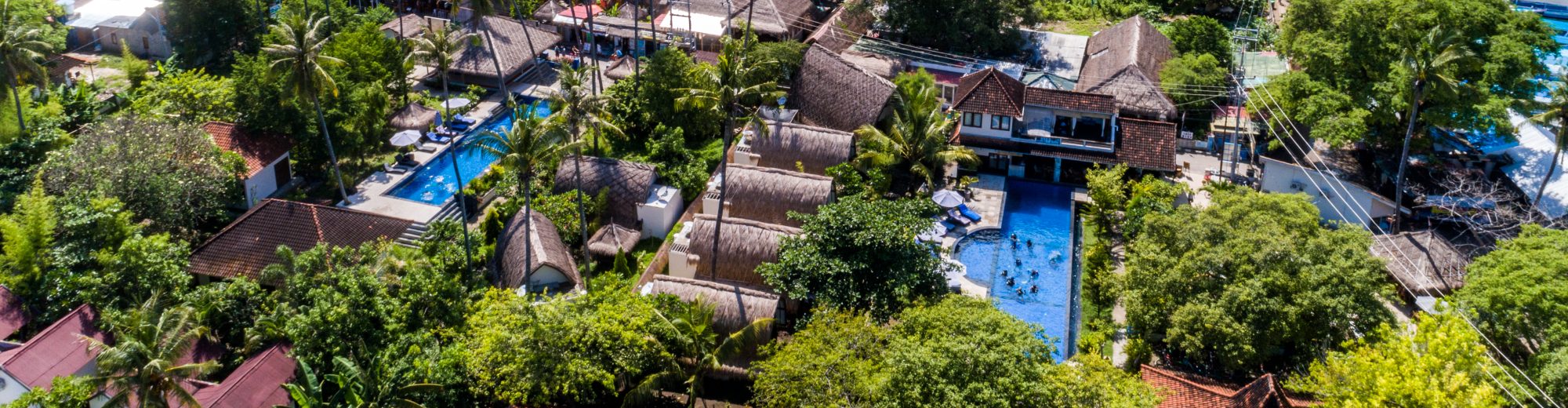
The resort features two large swimming pools.

The front pool is the lively heart of the resort, where divers prepare for their courses and guests enjoy cooling off after a day exploring the island.

Looking for something quieter?

Behind the resort you’ll discover our second pool, hidden away from the harbor. This peaceful oasis is often wonderfully quiet, making it the perfect place to read a book, swim a few laps, or simply enjoy the tropical surroundings in complete relaxation.

Many guests are pleasantly surprised to discover this hidden corner of Oceans 5.

Everything You Need in One Place

Oceans 5 offers much more than comfortable accommodation.

Right next to the main entrance you’ll find Allegria, a welcoming restaurant serving breakfast, lunch, dinner, fresh coffee, tropical juices, and a variety of international and Indonesian dishes. Whether you’re starting your day with breakfast before diving or enjoying dinner after watching the sunset, Allegria is always close by.

For guests who enjoy staying active, a modern gym is located behind the second swimming pool. Whether you’re maintaining your fitness routine or preparing for your next adventure, everything you need is only a short walk from your room.

A Resort for Divers and Non-Divers

While Oceans 5 is internationally known as an SSI Instructor Training Center and dive resort, many of our guests never put on a scuba tank.

Couples often visit where one partner dives while the other enjoys the pools, island cafés, beaches, or simply relaxes with a good book. Families appreciate the central location, making it easy to explore every corner of Gili Air without needing bicycles or horse carts. Digital nomads enjoy the peaceful environment between work sessions, while travelers looking for a few days of rest quickly discover how easy it is to slow down here.

You don’t need to be a diver to enjoy everything Oceans 5 has to offer.

Recharge Your Batteries

Life moves quickly.

Emails, meetings, deadlines, traffic, and constant notifications often leave little room to truly relax.

Gili Air is different.

The island has no cars or motorbikes. Instead, you’ll hear birds, the sound of the waves, bicycles passing by, and children laughing as they play on the beach. Time seems to slow down naturally.

At Oceans 5, we believe a holiday should do more than simply fill your calendar with activities.

It should give you the opportunity to recharge.

Whether that means spending your days diving among sea turtles, relaxing beside the hidden pool, watching the sunset with a fresh coconut, enjoying a seafood barbecue, or simply doing absolutely nothing, you’ll leave feeling refreshed both physically and mentally.

Because Oceans 5 Gili Air isn’t just a dive resort.

It’s a place where divers and non-divers alike can disconnect from everyday life, embrace the laid-back rhythm of island living, and return home with fully recharged batteries.

Family Bonding Through Scuba Diving on Gili Air

Family Bonding Through Scuba Diving on Gili Air | SSI Dive Resort Oceans 5 Gili Air

Family Bonding

Looking for a holiday activity that brings everyone together? Scuba diving is one of the most unique ways to create real family bonding. Unlike many sports and activities that separate people by age, level, or ability, diving allows parents and children to learn, explore, and share an unforgettable experience together.

Why Family Bonding Matters During Holidays

Family holidays are often planned with the idea of spending quality time together. But many activities do not include every family member at the same time. Sports like football, tennis, or ice hockey are usually divided into age groups or teams. Other activities are individual, meaning each person experiences them separately.

Scuba diving is different. From the age of 10, children can start their diving journey and get certified. This gives families the chance to enjoy the same activity, at the same time, in the same underwater world.

Scuba Diving: A Unique Family Bonding Experience

Scuba diving creates a special kind of family bonding because everyone shares the same adventure. Families learn dive theory together, practice skills in the pool, and complete ocean dives side by side.

These shared moments build trust, confidence, and communication. Parents can encourage their children, children can grow through new challenges, and the whole family can celebrate achievements together.

Gili Air: The Perfect Island for Family Bonding

Gili Air is one of the best destinations in Indonesia for a relaxed family holiday. The island has no cars and no motorbikes, creating a peaceful and safe atmosphere for families. Transport is by bicycle, electric bike, horse cart, or simply walking.

Everything on Gili Air is within walking distance. Families can enjoy beautiful beaches, calm island life, swimming pools, restaurants, and snorkeling spots without the stress of traffic or busy roads.

This makes Gili Air an ideal place for family bonding, both above and below the water.

Family Diving at Oceans 5 Gili Air

Oceans 5 Gili Air is an SSI Dive Resort offering diving courses for children, teenagers, and adults. Whether your family is trying scuba diving for the first time or wants to become certified together, Oceans 5 provides a safe and professional learning environment.

The dive resort has all the necessary diving equipment for children, including smaller tanks, wetsuits, BCDs, masks, fins, and other gear designed for younger divers. Proper equipment helps children feel comfortable, confident, and safe during their course.

Why Oceans 5 Gili Air Is Family Friendly

Oceans 5 Gili Air focuses on quality teaching, small groups, and personal attention. Instructors take time to make sure every student understands the skills and feels confident before moving forward.

For families, this approach is important. Every family member learns at their own pace, while still sharing the experience together. This makes the course more relaxed, more enjoyable, and better for long-term confidence.

More Than Diving: A Complete Family Holiday

A family diving holiday at Oceans 5 Gili Air is not only about scuba diving. Families can relax by the pool, play on the beach, explore the island by bicycle, enjoy local restaurants, or simply spend time together in a peaceful tropical setting.

For many families, this combination of island life and underwater adventure creates the perfect balance between relaxation and activity.

Creating Lifelong Family Memories

The first breath underwater is something most divers never forget. Experiencing that moment as a family makes it even more powerful. Seeing turtles, coral reefs, colorful fish, and the underwater world together creates memories that last far beyond the holiday itself.

This is what makes scuba diving such a powerful family bonding activity. It is not just something you do; it is something you share.

Start Your Family Bonding Adventure at Oceans 5 Gili Air

If you are looking for a meaningful holiday activity that brings your family closer together, scuba diving on Gili Air is a perfect choice. With a safe island environment, child-friendly facilities, professional SSI courses, and experienced instructors, Oceans 5 Gili Air offers the ideal setting for your family’s diving adventure.

Family bonding starts with shared experiences. At Oceans 5 Gili Air, those experiences can begin underwater.

April and May Diving in the Gili Islands

Gili Air Turtle | Diving in the Gili Islands | SSI ITC Dive Resort Oceans 5 Gili Air

Why It Is the Best Time to Dive with Oceans 5 Gili Air

When divers think about the best time to visit the Gili Islands, many people immediately think about the high season. But in reality, April and May diving in the Gili Islands is one of the best-kept secrets in Indonesia. These two months, just before the busy season starts, offer some of the most comfortable and enjoyable diving conditions of the year.

With flat seas, no waves, less current, and visibility between 20 and 30 meters, April and May are ideal months for both beginner divers and experienced certified divers. Whether you want to start your first diving course, continue your education, or simply enjoy fun dives in clear tropical water, the Gili Islands are the perfect destination. At Oceans 5 Gili Air, guests can enjoy these amazing conditions while staying in one of the most relaxed and professional dive resorts on the island.

Why April and May Are the Best Months for Diving in the Gili Islands

There is something special about the transition between the rainy season and the high season. In April and May, the ocean around the Gili Islands often becomes incredibly calm. The sea is flat, waves are minimal, and currents are usually lighter than in other months. These conditions make diving easier, safer, and more enjoyable for everyone.

Another big advantage is the visibility. During this time of year, visibility is often between 20 and 30 meters, which means divers can fully enjoy the reefs, coral formations, and marine life around the islands. Good visibility is also perfect for underwater photography, diver training, and relaxed fun dives.

Because the high season has not fully started yet, April and May are also quieter months. That means less crowded boats, more space on the island, and a more relaxed atmosphere both above and below the surface. For divers who want the best balance between great conditions and a peaceful holiday, these months are highly underrated.

The Gili Islands: A Diving Paradise in a Protected Marine Park

The Gili Islands, located off the northwest coast of Lombok, are famous for their white sandy beaches, turquoise water, and easy island lifestyle. But what makes them truly special is what lies underwater. The islands are part of Gili Matra Marine Park, one of Indonesia’s important marine protected areas and often mentioned among the country’s most valuable marine environments.

This protected status helps preserve the rich biodiversity of the area. The waters around the Gili Islands are full of life, making them attractive for divers of all levels. Turtle encounters are common, reef fish are everywhere, and the coral reefs provide shelter for a large variety of marine species. The area is suitable for people who want to learn to dive, but also for experienced divers who appreciate healthy reefs and marine diversity.

For many visitors, one of the biggest surprises is how much variety can be found in such a compact area. The Gili Islands combine beautiful reef diving with easy logistics, relaxed island life, and the comfort of short boat rides to the dive sites.

Perfect for Beginner Divers and Certified Divers

One of the reasons the Gili Islands diving scene is so popular is that it works for almost everyone. The calm conditions in April and May make this time of year ideal for people who have never dived before. If you are thinking about getting certified, these months provide a stress-free environment to learn new skills in the ocean.

At the same time, certified divers can enjoy easy fun diving conditions with excellent visibility and comfortable boat schedules. Short travel times to the dive sites mean less time spent on the boat and more time enjoying the holiday. Around the Gili Islands, the dive sites are generally located within 30 minutes from the dive center, which is a huge advantage compared to many other diving destinations.

This makes the islands perfect for couples, families, and groups with mixed interests. One person can join a diving course while another person enjoys the beach, yoga, or one of the many restaurants on the island. It is this combination of convenience and beauty that makes diving on Gili Air such an attractive holiday option.

Easy Diving Logistics Around the Gili Islands

One of the hidden luxuries of diving around the Gili Islands is how easy and comfortable everything is. At Oceans 5 Gili Air, dive trips are designed to be flexible and relaxed. The dive sites are close to the island, and after each dive, the boat returns to the dive center. This means divers are not stuck on a boat all day and can enjoy their surface interval in comfort.

Oceans 5 schedules three dives per day, giving guests plenty of options to plan their diving holiday. Because the boat always comes back after the dive, guests can choose to do one dive, two dives, or a full day of diving depending on their own pace and holiday plans.

This setup is one of the reasons why diving with Oceans 5 Gili Air feels so relaxed. You can go diving in the morning and still have time for lunch at a nice restaurant, a yoga session, a beach walk, or a sunset drink later in the day.

More Than Just Diving: Why Gili Air Is Perfect for a Holiday

Although diving is one of the main reasons people visit the Gili Islands, Gili Air has much more to offer than just the underwater world. It is a small island with a relaxed atmosphere, making it perfect for divers and non-divers alike. If you are travelling with someone who does not dive, they will still have plenty to do.

On Gili Air, visitors can enjoy yoga classes, cooking classes, beach cleanups, horse riding, paddle boarding, running clubs, gyms, and relaxed beach life. There are also plenty of bars and restaurants, so every day can feel different. You can spend the morning underwater and the afternoon exploring a new café, joining a wellness class, or simply relaxing by the pool.

This combination of diving and island lifestyle makes Gili Air one of the most complete tropical holiday destinations in Indonesia. It is not only a paradise for divers, but also a very comfortable place to spend time with family or friends.

Why Choose Oceans 5 Gili Air

Oceans 5 Gili Air is a professional SSI Dive Resort that offers diving experiences and courses from beginner to instructor level. Whether you want to try diving for the first time, complete your Open Water course, continue with advanced training, or become a professional dive leader, Oceans 5 can guide you through every step.

The dive center combines professionalism with a relaxed island atmosphere. Guests appreciate the quality of the operation, the short distance to the harbor and dive sites, and the flexibility of the daily diving schedule. Oceans 5 also offers 10 cosy rooms spread over the premises, so guests can stay in a peaceful and comfortable environment while being close to all facilities.

For people looking for a complete diving holiday, this is a major advantage. You can sleep, dive, relax, and explore Gili Air all from one central location. It is easy, convenient, and comfortable.

April and May Are Underrated Months for a Diving Holiday

Many travelers wait until the high season starts before planning their trip to the Gili Islands. But that means they often miss one of the best times of the year. April and May diving in the Gili Islands offers exactly what many divers are looking for: calm seas, good visibility, easy conditions, and a quieter atmosphere on the island.

These months are perfect for beginner divers who want a smooth introduction to scuba diving, and they are equally enjoyable for certified divers who want to explore the reefs in comfortable conditions. Add to that the relaxed lifestyle of Gili Air, the short boat rides, and the wide range of activities on land, and it becomes clear why this period is so special.

Book Your Diving Holiday with Oceans 5 Gili Air

If you are looking for the perfect tropical dive destination in Indonesia, Gili Air should be high on your list. And if you want to enjoy the very best conditions, April and May are the months to come. With flat seas, great visibility, less current, and a relaxed pre-high-season atmosphere, these are truly some of the best months to discover the underwater beauty of the Gili Islands.

Oceans 5 Gili Air welcomes divers of all levels and offers everything you need for an unforgettable holiday: professional SSI diving courses, fun dives, comfortable accommodation, and a beautiful island full of activities for divers and non-divers alike.

Come and experience for yourself why April and May are the most underrated months for diving around the Gili Islands and why Oceans 5 Gili Air is the perfect place to stay, dive, and enjoy island life.

SSI Divemaster Internship at Oceans 5 Gili Air

Become a Confident Dive Professional in 6–8 Weeks

If you are looking for a professional and ethical way to become a dive leader, the SSI Divemaster Internship at Oceans 5 Gili Air is the perfect next step. In just 6 to 8 weeks, Oceans 5 Gili Air will train you to become a confident divemaster through a structured program based on the SSI Divemaster curriculum, combined with extra workshops and real-world experience.

At Oceans 5 Gili Air, divemaster interns are not used as cheap labor. The focus is on high-quality education, personal development, and preparing you for a professional future in the dive industry. With a strong conservation philosophy, access to all SSI Ecology Specialties, and daily internship start dates, Oceans 5 offers one of the most complete divemaster internships in Indonesia.

Why Choose the SSI Divemaster Internship at Oceans 5 Gili Air?

Not all divemaster internships are the same. In some dive destinations, internship programs are used mainly to support daily operations. At Oceans 5 Gili Air, the philosophy is different. The internship is designed to give you the knowledge, confidence, and practical skills to become a professional divemaster who is ready to work in the real world.

The program follows the SSI Divemaster course standards and goes beyond the minimum requirements. During your training, you will not only improve your dive skills and watermanship, but you will also learn how to guide divers, assist instructors, solve problems, and act professionally in different dive situations.

This means that when you finish your internship, you will not just have a certification. You will have the confidence and experience needed to start your career in the dive industry.

A Professional Divemaster Internship, Not Cheap Labor

One of the biggest strengths of the Divemaster Internship at Oceans 5 Gili Air is its professional approach. Interns are not there to fill staff shortages or work for free without proper support. Instead, they receive real training from experienced dive professionals who care about quality and standards.

Your internship is built around learning. You will gain experience by assisting with real dive activities, but always as part of your professional development. Oceans 5 believes that good training creates good divemasters, and good divemasters are the future of the dive industry.

This ethical approach also supports the local community. Oceans 5 does not use internships to replace paid staff. That makes the internship not only better for the student, but also more responsible for the local economy on Gili Air.

What Will You Learn During the Divemaster Internship?

During the 6–8 week divemaster internship, you will complete the full SSI Divemaster training program and take part in extra workshops that help build your confidence and employability.

Topics covered during the internship include:

  • Assisting on real SSI courses and dive activities
  • Guiding certified divers safely and professionally
  • Improving your dive skills to professional level
  • Rescue skill refreshers and problem solving
  • Navigation and dive planning
  • Briefing and debriefing techniques
  • Equipment setup and dive logistics
  • Professional behavior and customer care

These practical elements are essential if you want to become a confident SSI Divemaster. Oceans 5 Gili Air focuses on creating dive professionals who can think for themselves, stay calm under pressure, and support divers in a safe and enjoyable way.

Extra Workshops That Go Beyond the SSI Curriculum

What makes the program even stronger are the additional workshops offered at Oceans 5 Gili Air. These workshops are designed to prepare you for the real demands of working in the dive industry.

Depending on the internship schedule and your development, these workshops can include:

  • Group control and guiding techniques
  • Environmental awareness workshops
  • Marine park rules and responsible diving practices
  • Rescue scenario refreshers
  • Professional dive center procedures
  • Customer communication and leadership skills

These extras give you more than just a certification card. They give you a stronger foundation for a future job in diving.

A Conservation-Friendly Dive Center with a Unique Advantage

Oceans 5 Gili Air is more than just a dive center. It is a conservation-friendly dive center located in the protected waters of the Gili Matra Marine Park. Environmental awareness is part of the daily philosophy of the dive center and part of the way training is done.

This is especially important for future dive professionals. As a divemaster, you are not only guiding divers underwater. You are also acting as an ambassador for the ocean.

Oceans 5 teaches divers and professionals to respect the marine environment. Good buoyancy, no touching marine life, and responsible behavior underwater are important values throughout the program.

SSI Ecology Specialties Make You More Employable

One of the special advantages of doing your divemaster internship at Oceans 5 Gili Air is the opportunity to expand your environmental knowledge through the full range of SSI Ecology Specialties offered at the dive center.

These specialties can include:

  • Marine Ecology
  • Coral Identification
  • Fish Identification
  • Shark Ecology
  • Sea Turtle Ecology
  • Marine Mammal Ecology
  • Marine Invertebrate Ecology
  • Nudibranch Ecology
  • Manta and Ray Ecology

Conservation is one of the hottest topics in diving today. Guests want to know more about the ocean, the reef, and the animals they see during their dives. Dive shops increasingly value professionals who can share this knowledge in an interesting and responsible way.

By adding ecology specialties to your training, you become a more employable divemaster. You do not only guide dives; you also bring extra value to the guest experience. That can make a real difference when applying for jobs in the dive industry.

Why Gili Air Is the Perfect Place for a Divemaster Internship

Gili Air is one of the best places in Indonesia to train as a divemaster. The island offers the perfect balance between professional training and island lifestyle.

The waters around Gili Air provide excellent training conditions, with warm temperatures, good visibility, and a wide variety of marine life. You can expect to see turtles, reef sharks, coral gardens, and even amazing macro life around the Gili Islands. These conditions help you build confidence in the water and make your training enjoyable at the same time.

Above the water, Gili Air has a relaxed and friendly atmosphere. There are no cars on the island, the beaches are beautiful, and daily life feels much less stressful than in many other busy dive destinations. This makes it easier to focus on your course, your diving, and your personal growth.

Why Oceans 5 Gili Air?

There are many reasons why divers choose Oceans 5 Gili Air for their professional training.

  • Professional SSI Divemaster Internship in 6–8 weeks
  • Interns are trained, not used as cheap labor
  • Extra workshops beyond the SSI curriculum
  • Strong conservation philosophy
  • Access to all SSI Ecology Specialties
  • Real experience in a professional dive center
  • Friendly and supportive training environment
  • Internships can start every day
  • Beautiful location on Gili Air, Indonesia

Oceans 5 combines quality training with a responsible approach to diving, conservation, and local community support. That makes it a smart choice for anyone who wants to become a professional divemaster the right way.

Divemaster Internships Start Every Day

Another major advantage is flexibility. Divemaster internships at Oceans 5 Gili Air start every day. You do not need to wait for a fixed course date. This allows you to plan your training around your travel schedule and start when it suits you best.

This flexible setup also allows for a more personal learning experience. Oceans 5 can focus on your progress, your strengths, and the areas where you need the most support.

Start Your Professional Diving Career at Oceans 5 Gili Air

If you are serious about becoming a dive professional, the SSI Divemaster Internship at Oceans 5 Gili Air is an excellent place to begin. In 6–8 weeks, you will grow from a recreational diver into a confident divemaster with real experience, strong environmental awareness, and skills that make you more valuable to future employers.

With high-quality training, extra workshops, ecology specialties, and the unique atmosphere of Gili Air, Oceans 5 offers much more than a standard divemaster course. It offers a complete professional development experience.

Start your divemaster internship at Oceans 5 Gili Air and take the first real step toward a professional future in diving.

Why Are People Not Respecting the Gili Matra Marine Park on Gili Air?

Why Are People Not Respecting the Gili Matra Marine Park on Gili Air?

Gili Matra | Gili Islands

Many newer investors may not realize it, but Gili Air is not just a tropical island with beautiful beaches and business opportunities. Gili Air is part of a protected marine park called Gili Matra. That status is not new, and it is not optional. It comes with rules, responsibilities, and legal boundaries that are meant to protect the future of the island.

The Gili Matra Marine Park covers roughly 30 square kilometers, including not only the surrounding sea but also the land area of the islands. It was established in 1993, long before tourism on the Gili Islands exploded and long before the area became a magnet for investors, dive businesses, resorts, restaurants, and other developments. At that time, the Indonesian government already understood that the islands and surrounding reefs were environmentally sensitive and needed protection.

Over the years, government departments changed names and structures, but the principle remained the same: this area is protected. Today, that responsibility falls under the Ministry of Environment and Forestry. The fact that the administrative structure evolved does not change the reality that Gili Air is part of a marine park with rules that should be respected by everyone, especially people making money from the island.

Gili Air Is Part of a Marine Park, Not a Free Development Zone

Being inside a marine park means there are regulations designed to protect nature, coastlines, reefs, and the long-term sustainability of the islands. These rules are not there to make life difficult for businesses. They exist because small islands are fragile. Once damage is done to the coastline or marine ecosystem, it is often difficult or impossible to reverse.

One of the most important and widely known rules in Indonesia is that construction is not allowed within 100 meters of the high tide line. On Gili Air, this issue became even clearer in 2018, when after socialization by the government it was agreed that building between the road and the coastline would not be allowed. Businesses had to remove and break down structures that violated these rules. That should have sent a clear message to everyone on the island.

And yet, years later, people still continue to build too close to the beach.

Why Are New Investors Ignoring the Rules?

After Covid, a new wave of investors arrived on Gili Air. Many saw opportunity in empty beachfront land or areas close to the sea. For some, the logic seemed simple: a beachfront location looks attractive, photographs well, and promises quick returns. But on a small island, empty land near the beach is often empty for a reason.

In many cases, these areas are vulnerable to beach erosion. The sea shifts during certain times of the year. Sand moves. Shorelines change. Anyone who understands island environments should know that building too close to the coast is not just risky for the business itself, but also risky for the wider island environment.

Still, too many people build first and think later. Instead of respecting the rules of the Gili Matra Marine Park, they focus on short-term profit. Instead of asking why land was left undeveloped, they assume they found a hidden opportunity that others overlooked. In reality, nature often left a warning long before they arrived.

The Problem With Building Too Close to the Beach

Once businesses build too close to the coastline, the consequences begin. Erosion starts affecting their property. Waves hit foundations. Sand disappears. The ocean starts reclaiming the space that should never have been built on in the first place.

And then comes the next mistake: seawalls.

Instead of accepting that the original construction was too close to the sea, some businesses start building walls to protect their land. These walls are often created with the sole purpose of defending private property, not with the wider environmental interest of Gili Air in mind. In some cases, these structures are made without proper government permits. They are built as a reaction to a problem that was caused by ignoring the regulations in the first place.

Illegal Seawalls Are Not a Solution for Gili Air

A seawall may appear to protect one business for a short time, but coastal systems do not work in isolation. What protects one stretch of land can easily increase erosion somewhere else. That means one property owner may save a piece of sand in front of their building while pushing the problem onto neighboring land or a different section of the island.

That is not sustainable development. That is shifting damage from one place to another.

On a small island like Gili Air, the impact of hard coastal structures can be serious. Seawalls can disrupt the natural movement of sand, change the way waves interact with the coast, and affect nearby shorelines and marine habitats. In a location that is supposed to be protected under the Gili Matra Marine Park, this kind of private decision-making can have public and environmental consequences.

If people choose to invest in a marine park, they should understand that they are not only responsible for their own business. They are also responsible for the impact of their choices on the island, the community, and the ecosystem.

Short-Term Profit Is Threatening the Future of the Island

The real issue is not just illegal construction or unapproved seawalls. The deeper issue is the mindset behind them. Too many people arrive on Gili Air with a short-term profit strategy instead of a long-term sustainability vision. They see the island as a place to make money quickly, rather than a fragile marine park that needs to be respected if it is to survive as a desirable destination.

This is dangerous for the future of Gili Air. The island’s charm comes from its beaches, reefs, natural beauty, community atmosphere, and relatively small scale. If development continues without respect for the law, that charm will be slowly destroyed by the very people trying to profit from it.

Every time a building is placed too close to the beach, every time someone ignores the setback rules, and every time a seawall is built without proper thought for the consequences, the island becomes a little less sustainable.

Respecting Indonesia Means Respecting Indonesian Law

There is also a simple moral question that should not be ignored. If you come to Indonesia to live, invest, or run a business, why would you not follow Indonesian laws and regulations? Why would you feel entitled to ignore rules that are there to protect the environment and the future of the island?

Would the same people behave this way in their own countries? Would they build inside a protected coastal area without permission? Would they alter a shoreline to protect a private development if environmental regulations clearly said otherwise? In most cases, the answer is probably no.

That is why this issue frustrates so many people on Gili Air. It is not only about buildings or business competition. It is about respect. Respect for Indonesian law. Respect for the protected status of Gili Matra Marine Park. Respect for the local community. And respect for the reality that islands like Gili Air need careful management, not careless development.

Why Protecting Gili Matra Marine Park Matters

The rules surrounding the Gili Matra Marine Park are not random. They exist because marine parks are supposed to protect fragile ecosystems from exactly this kind of uncontrolled pressure. Coral reefs, beaches, coastal vegetation, and island shorelines are interconnected. Damage one part, and the rest will eventually suffer too.

The success of Gili Air as a tourism destination depends on its environmental health. Divers, snorkelers, holidaymakers, and families do not come here to see damaged coastlines, erosion problems, and poor planning. They come for nature, relaxation, and island beauty. If development continues without respect for the marine park, then the very product being sold to visitors will slowly disappear.

Gili Air Needs Long-Term Thinking, Not Shortcuts

Gili Air does not need development at any cost. It needs responsible development. It needs investors and businesses who understand that sustainability is not just a marketing word. It is the foundation of the island’s future. That means respecting building setbacks, respecting marine park regulations, and understanding that not every attractive beachfront area is meant to be developed.

Authorities also need to remain consistent. If rules are only enforced once in a while, people will continue pushing the boundaries. If violations are ignored, the message becomes clear: regulations exist on paper, but not in reality. That is one of the fastest ways to weaken trust in conservation and allow environmental decline to continue.

For Gili Air to remain beautiful, liveable, and economically healthy, short-term thinking must be replaced with long-term responsibility. That responsibility belongs to government, businesses, investors, and everyone who benefits from the island.

Final Thoughts on Respecting the Gili Matra Marine Park

Gili Air is part of the Gili Matra Marine Park. That should be the starting point for every discussion about construction, coastal development, business expansion, and investment on the island. It is not just a nice detail. It is a legal and environmental reality.

The rules are already there. The history is already there. The protected status has existed for decades. So the real question is no longer whether Gili Air is protected. The real question is why some people still behave as if it is not.

If you choose to come to Gili Air, live on Gili Air, or invest on Gili Air, then respect the island. Respect the community. Respect Indonesian regulations. And most of all, respect the Gili Matra Marine Park, because without that protection, the future of the island is at risk.