Category Archives: watersport

Reef clean up dive Gili Air Gili islands great success

Oceans 5 dive resort organised another cleun up dive in the harbor of Gili Air, Gili Islands.

12 persons joined the clean up dive. The location was in the front of Oceans 5 dive resort. This is the spot where the fastboats arrive and leave. The tourists that take the fast boats to Bali leave a lot of garbage behind them and a lot of it comes in the water and sinks to the bottom.

After one hour of diving the result was 11 bags full of plastic, plastic bottles, can etc. The area needs more clean up. Hopefully we see you all next time.

For further information: info@oceans5dive.com

Seahorses in the harbor of Gili Air, Gili Islands, Lombok

The harbor of Gili Air is a really exciting dive spot. It one of the best muck diving spots around the Gili Islands. One of the main attractions are the 4 different kind of seahorses. You will find them straight in the front of Oceans 5 dive resort.

Seahorses are truly unique, and not just because of their unusual equine shape. Unlike most other fish, they are monogamous and mate for life. Rarer still, they are among the only animal species on Earth in which the male bears the unborn young.

Found in shallow tropical and temperate waters throughout the world, these upright-swimming relatives of the pipefish can range in size from 0.6 inches (1.5 centimeters) to 14 inches (35 centimeters) long.

Male seahorses are equipped with a brood pouch on their ventral, or front-facing, side. When mating, the female deposits her eggs into his pouch, and the male fertilizes them internally. He carries the eggs in his pouch until they hatch, then releases fully formed, miniature seahorses into the water.

Because of their body shape, seahorses are rather inept swimmers and can easily die of exhaustion when caught in storm-roiled seas. They propel themselves by using a small fin on their back that flutters up to 35 times per second. Even smaller pectoral fins located near the back of the head are used for steering.

They anchor themselves with their prehensile tails to sea grasses and corals, using their elongated snouts to suck in plankton and small crustaceans that drift by. Voracious eaters, they graze continually and can consume 3,000 or more brine shrimp per day.

Population data for most of the world’s 35 seahorse species is sparse. However, worldwide coastal habitat depletion, pollution, and rampant harvesting, mainly for use in Asian traditional medicine, have made several species vulnerable to extinction.
Beach and Reef clean up Gili Air, Gili Islands

Fantastic show up today for the beach and reef clean up in the harbor of Gili Air.

Special thanks for the students of the Bali International School (BIS). They teached the local kids to clean the island. Also Oceans 5 like to thank Blue Marlin Gili Air. They came with a lot of people and joined the clean up.

The end result was 10 bags of rubbish, still there is more. Hopefully we see you next wednesday!

Bumphead parrot fish around the Gili Islands, Indonesia

Bumpheads parrotfish are one the main attraction during a dive around the Gili Islands. When it is full moon there is a good chance to see them in big groups.

The Bumphead parrotfish is the largest of all parrotfishes, growing to 1.3 meters in length and 100 46 kg in weight. Adults are a dull green, with the front of the head pale yellowish to pink; juveniles are
greenish to brown with five vertical rows of small whitish spots. This species does not display sex-associated patterns of color change. Adults develop a bulbous forehead and their teeth plates are exposed (only partly covered by fleshy lips). The species is slow growing and long-lived (up to 40 years), with delayed reproduction and low replenishment rates

Bumphead parrotfish appear to recruit at low levels throughout the year but are not very selective about
which habitats they settle into. They live in coral reef habitats from 1-30 meter depth in the central
and western Pacific and Indo-Pacific. They occur in barrier and fringing reefs during the day, but
rest in caves or shallow sandy lagoon flats at night. Juveniles are found in seagrass beds inside lagoons while adults are more commonly found in outer lagoons and seaward reefs. This species is gregarious and usually occurs in small aggregations, but group size can be quite large (>75) on seaward and clear, outer lagoon reefs. They sleep in large groups, thus rendering them highly vulnerable to exploitation by spearfishers and netters at night.

Bumphead parrotfish is primarily a corallivore, but also eats benthic algae. They use their large head to ram corals and break them into pieces that are more easily ingested (each fish ingests over 5 tons of structural reef carbonates per year), contributing significantly to the bioerosion of reefs.

Aggregations of this species are important coral sand producers on reefs and may be important in maintaining ecosystem resilience.

They spawn pelagically during a lunar cycle near the outer reef slope or near promontories, gutters, or
channel mouths, and utilize spawning aggregations sites. Courtship and spawning has been reported to occur in early morning, although it may occur at other times.

Bumpheads around Gili Islands Indonesia

Bumpheads parrotfish are one the main attraction during a dive around the Gili Islands. When it is full moon there is a good chance to see them in big groups.

The Bumphead parrotfish is the largest of all parrotfishes, growing to 1.3 meters in length and 100 46 kg in weight. Adults are a dull green, with the front of the head pale yellowish to pink; juveniles are
greenish to brown with five vertical rows of small whitish spots. This species does not display sex-associated patterns of color change. Adults develop a bulbous forehead and their teeth plates are exposed (only partly covered by fleshy lips). The species is slow growing and long-lived (up to 40 years), with delayed reproduction and low replenishment rates

Bumphead parrotfish appear to recruit at low levels throughout the year but are not very selective about
which habitats they settle into. They live in coral reef habitats from 1-30 meter depth in the central
and western Pacific and Indo-Pacific. They occur in barrier and fringing reefs during the day, but
rest in caves or shallow sandy lagoon flats at night. Juveniles are found in seagrass beds inside lagoons while adults are more commonly found in outer lagoons and seaward reefs. This species is gregarious and usually occurs in small aggregations, but group size can be quite large (>75) on seaward and clear, outer lagoon reefs. They sleep in large groups, thus rendering them highly vulnerable to exploitation by spearfishers and netters at night.

Bumphead parrotfish is primarily a corallivore, but also eats benthic algae. They use their large head to ram corals and break them into pieces that are more easily ingested (each fish ingests over 5 tons of structural reef carbonates per year), contributing significantly to the bioerosion of reefs.

Aggregations of this species are important coral sand producers on reefs and may be important in maintaining ecosystem resilience.

They spawn pelagically during a lunar cycle near the outer reef slope or near promontories, gutters, or
channel mouths, and utilize spawning aggregations sites. Courtship and spawning has been reported to occur in early morning, although it may occur at other times.

Bungalows Oceans 5 dive resort on schedule

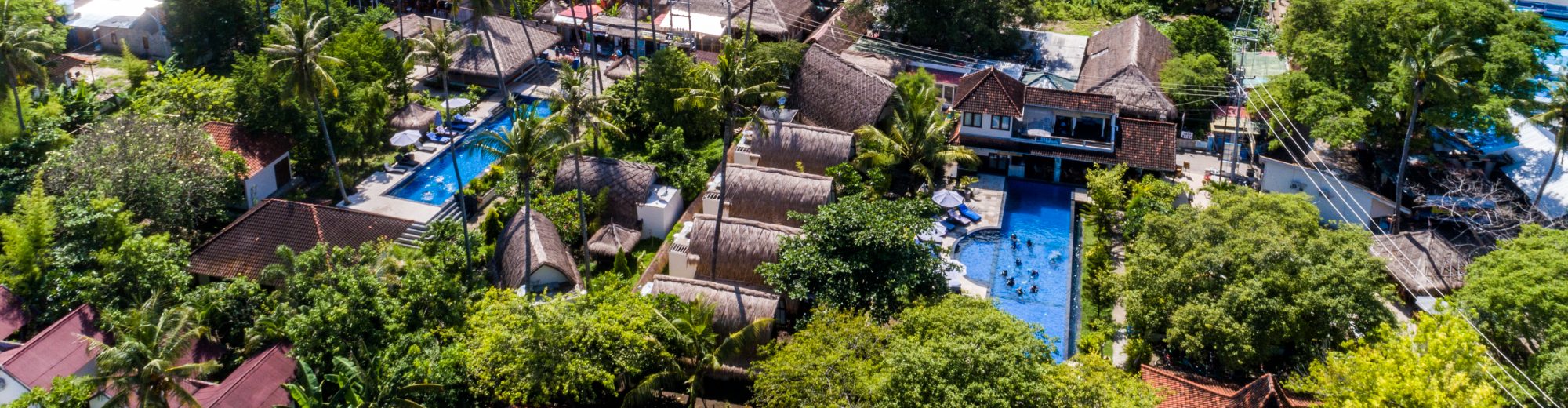
Oceans 5 dive resort is building a new restaurant, a family bungalow and 2 standard room since last March.
The building of the standard rooms are almost finsished. Within 1 month is it possible for you to have your holiday at a tropital paradise in one of these rooms. The rooms have AC, WIFI, queensize bed, teras, access to swimming pool.

If you like to have a little bit more luxury, in 2 months the family bungalow will be finished. It is possible to stay with 4 persons in this bungalows, there is a kingsize bed and 2 seperate beds. The bungalow will have AC, hot water, WIFI, access to the pool, pool view and satelite TV.
For all the persons who are hungry or want to have a drink there will be a restaurant to that serves food and drinks.

One of the problems on the Gili Islands is beach erosion. Beach erosion is defined by the actual removal of sand from a beach to deeper water offshore or alongshore into inlets, tidal shoals and bays. Such erosion can result from any number of factors, including the simple inundation of the land by rising sea levels resulting from the melting of the polar ice caps.

In the last few year there was a lot of beach erosion around the Gili Islands.
Specially the North Coast of the Gili Islands and more actual the East Coasts of the Gili Islands lost a lot of beach in the last couple of years. Meters of beach dissapeard at the last storm in March 2012.Of particular concern is the effect climate change, which not only causes sea levels to rise but also increases the severity and possibly the frequency of harsh storms, has on beach erosion. While sea level rise sets the conditions for landward displacement of the shore, coastal storms supply the energy to do the ‘geologic work’ by moving the sand off and along the beach. Therefore, beaches are greatly influenced by the frequency and magnitude of storms along a particular shoreline.Besides collectively lowering our greenhouse gas emissions substantially, there is little that individuals—let alone coastal landowners—can do to stop beach erosion. Building a bulkhead or seawall along one or a few coastal properties may protect homes from damaging storm waves for a few years, but could end up doing more harm than good. Bulkheads and seawalls may accelerate beach erosion by reflecting wave energy off the facing wall, impacting adjacent property owners as well, adding that such structures along retreating shorelines eventually cause diminished beach width and even loss.

Oceans 5 dive resort is trying to save some beach by replanting trees on the beach. The sand will not move that quick and hopefully the beach erosion doesnt goes that fast as in the past.

Oceans 5 dive resort dives against debris, Gili Islands

The last couple of weeks the weather was not as normal. Big waves, heavy rains, strong winds and thunderstorms were an every day event on the Gili Islands. This didnt make is easy to organise a clean up dive. But last week the weather changed. And it become beautiful as normal.

Oceans 5 dive resort organised again a dive against debris. 11 Oceans lovers joined the dive and collected all kind of rubbish. Beer bottles, cans, platic bags, plastic papers, oil bottles, sunglasses, etc is what the divers took out of the Harbor. This time it were 8 bags of rubbish. Oceans 5 dive resort like to thank all the people who helped them to collect the rubbish and make the ocean a bit better.  

Oceans 5 dive resort organises every wednesday a dive against debris. It is free and everyone can join. For more information: info@oceans5dive.com