Category Archives: watersport

Facts about Batfish

A lot of times you see them around when you are diving Sharkpoint, Gili Trawangan or Bounty Wreck, Gili Meno. Its the Batfish. They are so common when and we see then so many times around the Gili Islands, but what do we know about them?

Batfishes are recognisable on the basis of their distinctive shape, particulary juveniles, which have greatly elevated dorsal and anal fins. Other characteristics include a small, terminally located mouth, brush like jaw teeth (often with tricuspid lips), a continuous dorsal fin with 5-9 spines and 19-40 soft rays, anal fin with 3 spines and 17-29 rays, and typically a silvery adult colour pattern often with dark bars on the head and body.

Members of the genus Platax are extremely tame and curious, often approaching divers at close range.

Young fish are found close to the bottom, often around boat moorings, docks, jetties, and floating objects. Adults may form midwater feeding aggregation, frequently adjacent to steep outer reef slopes.

The diet consists largely of benthic invertibrates and zooplankton.

In their natural habitat the young of P. orbicularis mimic dead leaves, and those of P. pinnatus mimic toxic polyclad flatworms that are nearly identical in colour and shape.

Facts about Barracudas

When you are diving around the Gili Islands you have a chance to see at the divesites Sharkpoint, Hans or Halik the Barracuda. Also in the evenings when you pass all the BBQ places for dinner, the barracuda is one of the most seen dishes. But how does it looks like?

Description

The great barracuda has a slender, streamlined body that is round in the mid-section. The top of the head between the eyes is nearly flat and the mouth is large, containing many large sharp teeth and a projecting lower jaw. The pectoral fin tips extend to the origin of the pelvic fins. The spinous and soft dorsal fins are widely separated and the double emarginate tail fin exhibits pale tips on each lobe. Body coloration of the great barracuda is brownish or bluish gray on the dorsum and upper side, with a greenish cast shading to silvery on the sides and a white belly. The upper side may have 18-23 dark bars most often observable when the fish is resting or over a variegated substrate. The black spots on the lower sides of the great barracuda distinguish it from other species of barracuda. The second dorsal fin, anal, and caudal fins are violet to black with whitish tips. Young barracuda exhibit pale reticulations on the dorsum and a dark stripe on either side that breaks into spots as the fish grows. These patterns are somewhat ephemeral though as juveniles can alter their color patterns to closely match that of their surroundings. These changes in coloration serve to camouflage the fish from predators as well as well as wary prey. Adults have similar coloration along with a more silvery appearance that is advantageous to a fish that swims near the surface of the water.

Habitat

Great barracuda commonly occur in nearshore coral reefs, seagrasses, and mangroves. They may also reside in the open ocean, living predominantly at or near the surface, although they are at times found at depths to 100 meters. Barracudas tend to be solitary but are sometimes found in small aggregations over reefs and sandy bottoms. Juveniles mature amongst mangroves and seagrass beds, habitats that offer cover from predators. During the second year of life, barracuda move to deeper reef habitats. Juveniles and some adults have been observed in areas that receive high amounts of freshwater input, however adults generally tend to avoid areas of brackish water.

Diet

Great barracudas feed on an array of prey including fishes such as jacks, grunts, groupers, snappers, small tunas, mullets, killifishes, herrings, and anchovies. Barracudas have a large gape and very sharp teeth, enabling them to feed on large fishes by chopping them in half. An opportunistic predator, great barracuda feed throughout the water column. Generally a diurnal fish, great barracuda locate their prey largely by sight. The body plan of the great barracuda is designed for speed and it is estimated that top speed for the species may be as fast as 60 km/h.

Fishery

Although not prized as a commercial fish in North American waters, the great barracuda puts up a good fight and is therefore esteemed by some anglers as a gamefish. They may be caught with a variety of gear including handlines, rod and reel, seines, trammel nets, and gill nets. The great barracuda has been implicated in cases of ciguatera poisoning within certain areas of its range. Ciguatera poisoning is caused by the bioaccumulation of ciguatoxins in the flesh of tropical marine fishes. Ciguatoxins are produced by marine dinoflagellates that grow attached to marine algae and as such may be incidentally ingested by herbivorous fishes. Large piscivorous reef dwelling fishes occupying the apex of the food chain become reservoirs for the highest amounts of ciguatoxin by feeding on other members of the reef community. Poisoned people report gastrointestinal maladies that may last several days, a general weakness in their arms and legs, and a reversal in the ability to differentiate hot versus cold. The illness is serious and symptoms may persist for weeks.

Size

Great barracuda are large fish. The record for a hook and line caught great barracuda is 1.7 meters, 44 kg and the species is reported to attain a size of 2 meters, 50 kg. Any barracuda over 4.8 feet (1.5 m) in length can be considered very large. Based on scale analysis of large specimens, great barracuda have a lifespan of at least 14 years. Sexual maturity is reached at a length of about 60 cm.

Range

Occurring worldwide in near shore tropical and subtropical seas (30°N – 30°S), the great barracuda is common in the western Atlantic Ocean from Massachusetts (U.S.) to Brazil. It is also found in the Gulf of Mexico and the Caribbean Sea as well as the eastern Atlantic Ocean, Indo-Pacific, and the Red Sea. It is rare or absent in areas of the eastern Pacific Ocean.

For mor information: http://www.oceans5dive.com
Facts about Scorpion fish

A scorpion fish is a group of predatory, marine fish that are found amongst coral reefs and in shallow waters in the more temperate oceans. The scorpion fish is most closely related to the lionfish and is most commonly found in the Indian and South Pacific oceans. You can find them if you dive around the Gili Islands at the dive sites Hans reef, Halik and the Bounty. Oceans 5 dive resort finds almost every dive a scorpion fish.

There are more than 200 recognised species of scorpion fish, hiding amongst the ocean reefs and in artificial aquariums around the world. Scorpion fish are kept in tanks by numerous people because of their interesting appearance and behaviour.

The body of the scorpion fish is often cover in feathery fins that help the scorpion fish to camouflage itself into the surrounding coral. The colours and markings of the scorpion fish are also used to help the scorpion fish to hide.

Scorpion fish are nocturnal predators, and spend the daylight hours resting in a hidden crevice in the coral. Scorpion fish are also able to ambush their prey from this position and often catch small fish by surprise.

Scorpion fish are omnivorous fish and hunt small fish, crustaceans and snails on the coral reefs. Scorpion fish are able to stun their prey with their venom before eating it. Scorpion fish also use their venomous sting to fend off unwanted predators.

The scorpion fish is a very dominant predator in it’s environment, and therefore the scorpion fish has very few natural predators. The human catching the scorpion fish to keep in tanks is the biggest threat to the scorpion fish along with habitat loss from the destruction of coral reefs. Large fish and sea lions are also known to hunt scorpion fish.

The female scorpion fish releases between 2,000 and 15,000 eggs into the water which are fertilised by the male scorpion fish. The scorpion fish pair then quickly hide so that their eggs can float into the ocean before being spotted by predators that eat the eggs. The scorpion fish eggs hatch in just 2 days and the tiny scorpion fish fry remain near the surface of the water until they are bigger. When the scorpion fish fry reach nearly an inch in length, they swim down into the ocean to join the reef community.

Facts about Damsel fish

The Damselfish are quite lively and colorful and they are common in the tropical seas. They are found in the shallow water of tropical and semitropical seas, like diving around the Gili Islands and at the divesites Halik (North Gili Trawangan), Hans reef (North Gili Air) and Bounty Wreck (South West Gili Meno). They are small and aggressive. They love the coral reefs, mangroves and sea grass. They feed on zooplankton and algae. When they are in courtship, they make purring and clicking noises. The juveniles are different in color than the mature adults. Some juveniles may be red with blue spots. The mature ones are orange-yellow. They can display a ferocious behavior when they feel threatened. Some like to live in open water and swim in schools. These fish are beautiful as the display their bright colors.

Many of the Damselfish grow to a length of 7 cm. They become mature in two to five years. Some species may take much longer to mature. Their spawning season begins in spring and ends in the summer. There are a few different species and some species swim in large schools.

There are about 235 species of Damselfish, and that includes about 26 species of Clownfish. Habitat destruction and the destruction of the coral reefs may soon show declining populations.

The young Blue Damselfish can live together in peace, but they become very aggressive as they mature. They like to stay very close to the coral reef.

The Black and White Damselfish are also called Humbug fish. The Yellowtail Damselfish often lose their beautiful bright colors when they are captured. Some species of Damselfish can only be found in the Caribbean. Some species only live on the bottom of the sea and they defend their territory of about 16 feet. This territory covers feedinmg, spawning and shelter sites. The Damselfish ignores bass and groupers because they are much less competitive. It is the male that prepares for spawning by clearing a surafce of coral or rocky ledge. The female can lay up to about 20,000 oval eggs that are really tiny. The males guards these eggs with his fins. It takes the eggs about three to seven days to hatch.

If you like more information about diving around the Gili Islands visit our website: http//:www.oceans5dive.com

Oceans 5 goes sidemounting!

Oceans 5 dive resort is following the latest trends of diving. In the beginning of October 2012 Oceans 5 dive resort will be ready to teach sidemounting around the Gili Islands. They will be the first or one of the first who are cabable to teach sidemounting arounf the famous Gili Islands.

Oceans 5 ordered just 2 Hollis sms50 sidemount systems. And if we like them more will follow.

What is sidemount scuba diving..?

Diving in sidemount configuration is the process of taking one or two cylinders and placing them on either side of your body, rather than mounting them on your back, (traditionally known as backmounted). But Sidemount diving is much more than just a change in equipment. In fact, with the right training, you will find it to be a vastly more rewarding and enlightening experience.

If fact if trained correctly I doubt, you will ever see the need to return to a backmouted equipment configuration.

Why use sidemount equipment configuration vs backmount..?

* Enables a unique method of buoyancy control which results in a more streamlined profile, reduces drag and makes finning and moving through the water much easier and more efficient. Get as close to the free-diver experience as possible with Scuba!

* Offers a greater comfort level. Sidemount equipment and harness are custom fit to each individual, accommodating divers of all shapes and sizes.

* Great for divers with any disabilities, as you carry the cylinder(s) separate from your harness to the water. Cylinders and weights are then mounted and attached in the water, making the entries and exits to dive sites much easier.

* The safest option in terms of air management. Sidemount allows provides you with easier access to your cylinder valve(s), first stage(s) and alternate air source should a problem arise.

One harness and BCD does it all! This statement is now 100% true! Your Sidemount equipment can also be used for more advanced types of diving i.e wreck, technical and cave diving, providing you get trained correctly at each level.

If you like to have more information about sidemounting around the Gili Islands: http://www.oceans5dive.com or info@oceans5dive.com

Reef clean up Gili Air, Gili Islands 19th July

Yesterday is was clean up day at Oceans 5 dive resort. It means clean up the beach, the oceans and the reefs in front of Oceans 5.

Oceans 5 is located in the harbor of Gili Air. All the fast boats from Bali are arriving there and that means a lot of tourist leave their garbage behind and that dissapear in the ocean.

Oceans 5 organises every week a clean up, cuz the reef in front of the resort is a brilliant reef to see all kind of things, like seahorses, pipefish, nudis, mimic octopus and mandarin fish. Also Oceans 5 likes to make more people aware how important the oceans are for our planet.

This time 7 people joined the clean up and the result was 6 bags full of rubbish.

Oceans 5 like to thank every one who joined and for who wants to join : info@oceans5dive.com or come into our shop on Gili Air, Gili Islands.

Busy times, high season is starting….

The last few days the amount of people arriving on Gili Air is increasing. We see them every day arriving in front of Oceans 5 dive resort with the fast boats from Bali.

Not all of the people who are visiting Gili Air are diving but a lot of them do. Diving, and snorkeling are the main attractions of the island. It is beautiful world under the water and you can find it all around the Gili Islands.

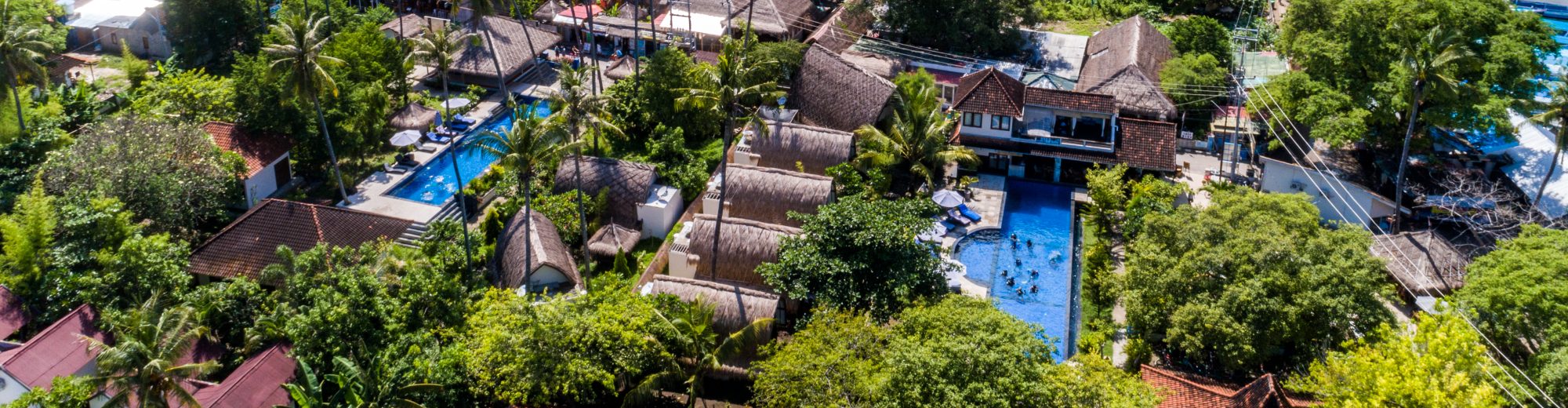
For people who never dived before, there are pools to try scuba diving, like the Oceans 5 pool. A 25 meter pool specially made for scuba diving. It is a perfect place to start your first dive experiences.

Yesterday Oceans 5 dive resort had 21 students in the pool. If you look at the picture you will see there is space for everyone, and that the instructor are teaching only small groups, max 4 persons.

If you like more information about scuba diving around the Gili Islands: info@oceans5dive.com

Turtle release and beach/reef clean up at Oceans 5 dive resort

Oceans 5 dive resort is taking care of their environment. They do with with their weekly beach and reef clean up in the harbor of Gili Air, Gili Islands. But also Oceans 5 has a turtle conservation programme.

Yesterday Oceans 5 did a clean up in the harbor of Gili Air with 6 people. They found a lot of rubbish, in total 6 bags. Plastic bottles, cans, chips bags, wood, stone, glass, etc are the main part of the collected rubbish.

A few hour later Oceans 5 released 25 turtles. They have been for 3 months at Oceans 5 dive resort and they are now big enough to experience the real world. In the beginning they didnt know where to go, but all found their way to the water and dived into it. After a few goodbyes all turtles decided to swimm yo the deep part. Hopefully we see them one day….

Weekly beach and reef clean up Gili Air, Gili Islands, Lombok

Yesterday 12 people joined the beach and reef clean up in the front of Oceans 5 dive resort, Gili air, Gili islands.

After sorting out all the equipment there was a briefing about the dive site, max dive time, max depth, what kind of rubbish we should take, how to take out the rubbish and be aware that some rubbish is already new living for someone…

Before the buddy teams were formed everyone has got some gloves and a bag.

After one hour of diving the result was 10 bag full of rubbish, all kind of things.

Dont think that the divers didnt see anything else than plastic, thats not true. Seahorses, pipefish, mimic octopus etc were all around during the clean up.

For more information: info@oceans5dive.com

Weekly reef clean up day at Gili Air

Every week Oceans 5 dive resort tries to organise a beach and reef clean up in the front of their dive resort.

Last week 16 persons joined the the reef clean up. The group was split up in smaller groups with all their own local divemaster. The result of the clean up was 12 bags of rubbish. Its all kind of rubbish.

The dive site looks a bit better now and Oceans 5 dive resort like to thank all the the people who joined the clean up and think about the environment around the Gili Islands.

For more information: info@oceans5dive.com