Tag Archives: dive gili air

Diving during rainy season

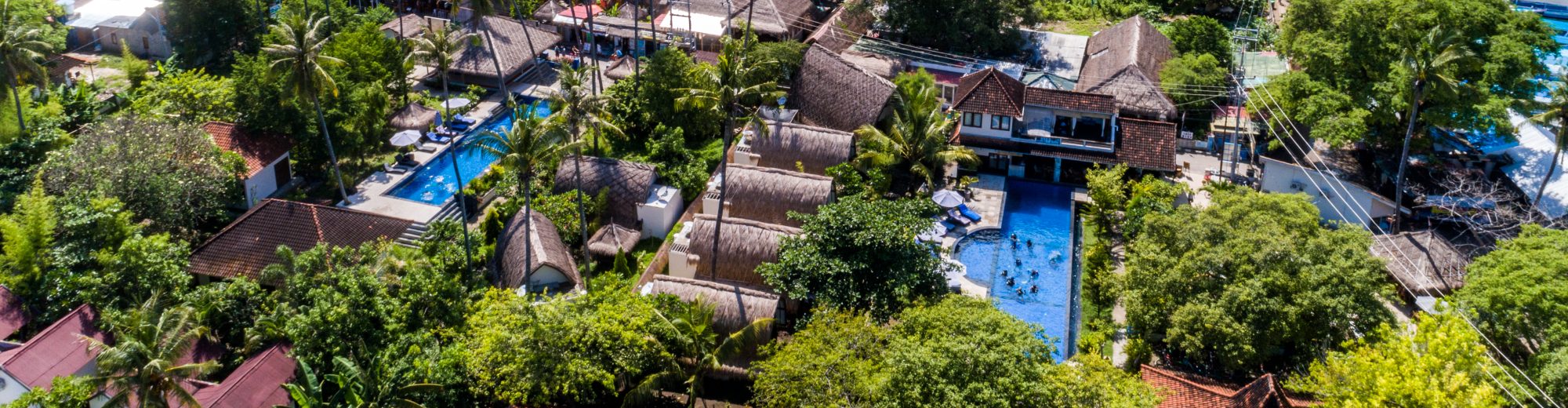
Dive resort Oceans 5 Gili Air and the island during rainy season
Oceans 5 caters fundivers and organises courses, including IDC’s (Instructor Development Courses), the whole year round.

image.jpg
Wet season arrives roughly somewhere in November and ends start of May, with the occasional rain showers in the month after. Because of their geographic location, the Gili Islands enjoy a very comfortable micro climate. The rainclouds tend to pass over as they get drawn towards the big volcanoes on Lombok, which results in a maximum of 2h of rain on average a day.
During this time the islands turns into a lush, green place where wildlife flourishes. You hear the mating calls from our resident Tokeh Tokeh’s (big gecko’s) around sunset, baby monitor lizards playing around in swimming pools, butterflies dancing and our tropical birds feeding their newborns.

The water temperature in the ocean stays fairly constant (27-30), with a slight drop of visibility due to all the nutrients coming in when our currents shift occassionally. This brings a big behavioural change in our marine eco system. Plenty of food to go by for all the species we have around the Gili’s. You can see fry and fingerlings feeding in great numbers, which provides food for some bigger fish and the ball starts rolling. The result is divers enjoying eventful dives with a lot of action.
Our macrolife also has its share of all the riches this time of the year, which makes the islands perfect for photographers during rainy season.
And last but not least we have whalesharks, manta rays and devil rays passing by on occasion to feed on all the goodies. While there is never any guarantee to see them, rainy season is where you have the best chance of spotting them.

This time of the year brings changes, and these changes are welcome every year! Its amazing how a bit of water can change both the look of the island, and everything and everyone that lives on and around the islands.
Come and experience a green lush paradise where diving will stun you. Sign up for a course if you’re not a diver yet, book fundives with our amazing local guides who will take you on a tour in their underwater backyard or sign up for your IDC if you would like to teach people how to dive in places like Gili Air.

For more information visit our websites:
http://www.oceans5dive.com
http://www.indonesia-idc.com


What’s Julie’s Tropical day on Gili Air?

20130123-125853.jpg

Bartender Juli

Juli started working at Oceans 5 dive resort, in Gili Air Indonesia, around 6 months ago. He is originally from Lombok. The closest, “main land” island. He’s from a village called Karang Pangsor. Not far from Bangsal, the main harbour to get to Gili air. His family still lives in Karang Pangsor. Just a 20 minute boat ride away. Which makes it easy for him to visit his family. He loves working on the Gili’s, because in the village he gets a little bored and there are no work oportunities. He used to work at Bangsal harbour, which has a welknown reputation of being a fairly not so enjoyable place. Continue reading

Facts about Rabbitfish


Rabbitfish (Siganidae)

Rabbitfish are common inhabitants of Indo Pacific reefs, like the waters around the Gili Islands.

Read more….

Facts about Bigeyes

Bigeyes (Priacanthidae)

Bigeyes are distinctive fish characterised by brilliant red colouration, small scales and large glassy eyes.

Additional features include a relatively deep, laterally compressed body, very oblique mouth with a strongly projecting lower jaw, small conical jaw teeth in narrow bands, very small scales that are rough to touch, a scaled head, ans a relatively large pelvic fins, which are joined to the abdomen by a membrane.

Although usually red, most species are capable of rapid colour changes, often assuming a heavily blotched, barred, or silvery pattern.

As their large eyes might suggest, they are nocturnally active, feeding on a variety of ocropus, crustaceans, and small fish.

During the day bigeyes are commonly seen sheltering close to the reef, usually in vicinity of caves or ledges.

Some species range into deep water, at least down to 400 meter.

They are commonly seen onb the reefs around the Gili Islands.

Facts about Anthias

Anthias (Anthinae)

Anthias , much smaller than their grouper relatives, also play an important role in the reef community. Anthias in particular are very abundant in terms of number of individuals and often form huge mid water feeding aggregations, especially adjacent to steep outer reef drop-offs, like when yo are diving around the Gili Islands Halik Reef.

Read more….

Reef Clean Up Gili Air with Oceans 5

Yesterday Oceans 5 dive resort organized another reef clean up. Instructor Phil, Divemaster Yvonne and Divemaster Trainee Budi took care of 7 other divers who wanted to help.

The clean up started at 16.00. At that time the preparation started with preparing the bags, the gloves and all the equipment. At 16.30 Divemaster Yvonne gave a dive briefing about how everyone should take the rubbish away, the bottom time, the max depth and buddy teams.

The first divers came after 44 minutes out of th water. They had 3 bags full of rubbish. After this each buddy team and the result was shocking……

After we had last time 15 bags of rubbish now the divers collected another 12 bags of rubbish! It looks a little bit better in the front of Oceans 5 dive resort, but still a lot of work has to be done.

For further information about the reef clean ups: info@oceans5dive.com

Facts about Batfish

A lot of times you see them around when you are diving Sharkpoint, Gili Trawangan or Bounty Wreck, Gili Meno. Its the Batfish. They are so common when and we see then so many times around the Gili Islands, but what do we know about them?

Batfishes are recognisable on the basis of their distinctive shape, particulary juveniles, which have greatly elevated dorsal and anal fins. Other characteristics include a small, terminally located mouth, brush like jaw teeth (often with tricuspid lips), a continuous dorsal fin with 5-9 spines and 19-40 soft rays, anal fin with 3 spines and 17-29 rays, and typically a silvery adult colour pattern often with dark bars on the head and body.

Members of the genus Platax are extremely tame and curious, often approaching divers at close range.

Young fish are found close to the bottom, often around boat moorings, docks, jetties, and floating objects. Adults may form midwater feeding aggregation, frequently adjacent to steep outer reef slopes.

The diet consists largely of benthic invertibrates and zooplankton.

In their natural habitat the young of P. orbicularis mimic dead leaves, and those of P. pinnatus mimic toxic polyclad flatworms that are nearly identical in colour and shape.

Facts about White tip reef sharks

Sharkpoint, West Gili Trawangan, Indonesia is one of the most exciting divesites around the Gili Islands. It takes 30 minutes by boat from Oceans 5 dive resort to get there. The main attraction are the White Tip Reef Sharks. You will find them between the 20 and 30 meters in the sandy patches between the reefs, mostly sleeping.

Description and Behavior

Whitetip reef sharks, Trianodon obesus, are a slender species with a short, blunt snout. They are brown-gray on their dorsal (top) sides, white on their ventral (lower) sides. They have scattered dark gray spots along the sides of their bodies.

The tips of their first dorsal fin and upper caudal (tail) fin lobe are brilliant white. The tip of their second dorsal fin and lower caudal fin lobe are also white in some animals. Spiracles usually present, teeth are tricuspidate (three-pronged, with a smaller secondary cusp on either side of the central blade) numbering 47-50 upper/44-46 lower jaw, in at least 2 functional rows.

This species is reported to grow to 2.3 meters in length but adults over 1.6 meters long are rarely seen. Maximum published weight is 18 kg and the maximum reported age is 25 years.

World Range and Habitat

Whitetip reef sharks are found in tropical marine waters, are most abundant on the fore-reef, and during daylight hours are often associated with coral reefs or lying on the bottom in caves and under ledges. Individuals often return to favored resting sites at the same times each day, often for several years. Highly social, these sharks often lie together in groups on the bottom, stretched out side-by-side and even stacked like chord wood. Home ranges of individuals are very small, typically only 0.5 km² or so.

In Australia they are recorded from northwestern Australia, around the tropical north and south to the Queensland coast. They are one of the most abundant species found near coral reefs, together with blacktip reef sharks, Carcharhinus melanopterus, and gray reef sharks, C. amblyrhynchos. They prefer shallow water, but have been found down to 330 m. These sharks live near the bottom or in caves and crevices. Compared to typical reef sharks (requiem sharks), this species swims in a more undulating manner. They are primarily nocturnal, but seem to be correlated with tidal ranges. They can be found in the same area for months (a few square kilometers) but territoriality is not known. They are sluggish inhabitants of lagoons and seaward reefs where they are often found resting in caves or under coral ledges during the day, or usually on a sand patch, or in a channel. They are more active at night or during slack tide in areas of strong currents. They are known to travel distances from about 0.3-3 km in periods up to about 1 year.

Feeding Behavior (Ecology)

Whitetip reef sharks feed nocturnally on benthic animals such as fishes, octopuses, spiny lobsters, and crabs. They have been observed feeding cooperatively at night at Cocos Island, Costa Rica, moving over the reef face like a phalanx of soldiers, flushing out sleeping prey. Foraging individuals often pause to wriggle their elongate bodies into crevices and under coral heads, twisting and turning violently and often breaking off coral and tearing their fins and skin. As such, the whitetip reef shark occupies a niche more like that of a moray eel than a typical shark.

Life History

One to five 60 cm young per litter. Mode: dioecism. Fertilization: internal (oviduct). Reproductive guild: internal live bearers. Description of life cycle and mating behavior: Viviparous, with 1-5 young per litter. Gestation is about 12 months. Size at birth 52-60 cm total length. Distinct pairing with embrace. One to 11 males follow a female until one gently nips her gill region; if she accepts him, he grasps one of her pectoral fins in his mouth and mates with her, their heads close together on the bottom and their bodies entwined and extending up into the water column at an angle of about 45 degrees. Mating typically lasts 1.5 to 3 minutes. They reach sexual maturity at an age of about 8 years and a length of about 1 m (males and females). Size at birth 52-60 cm total length.

Conservation Status and Comments

Check the Conservation Status of Whitetip Reef Sharks Note: if there are no entries found, it only means that this species has not yet been evaluated.

The whitetip reef shark is a curious species that often approaches divers. It is not considered dangerous to humans. Its restricted habitat, depth range, small litter size and moderately late age at maturity suggest that, with increasing fishing pressure, this species may become threatened .

Rarely reported to attack humans, but is potentially dangerous, particularly when when fish have been speared. Probably fished wherever it occurs (no data). Meat and liver utilized fresh for human consumption. The liver of this shark has been reported as toxic.
Facts about Moray Eel

The moray eel is a large species of eel found in warm and temperate waters all around the world. They are also around the Gili Islands. Despite their snake-like appearance, moray eels (along with other eel species) are in fact fish and not reptiles.

Moray eels are found in both deep and shallow waters in tropical and sub-tropical regions. Although moray eels can be find in cooler waters occasionally, they tend to remain in the crevices deep in the ocean rather than venturing into shore. The largest populations of moray eels are found around tropical coral reefs where they are numerous different marine species found in large numbers. Specially when you are diving the dive sites around the Gili Islands named Halik, Hans and Bounty wreck you will see them.

There are around 200 different species of moray eel than can range in size from just 10cm long to nearly 2 meters in length. Despite their varying size and colour all moray eels are fairly similar in appearance with an elongated body, slightly flattened towards the tail. Moray eels also have large eyes and mouths which contain large teeth.

The moray eel is a relatively secretive animal, spending much of its time hiding in holes and crevices amongst the rocks and coral on the ocean floor. By spending the majority of their time hiding, moray eels are able to remain out of sight from predators and are also able to ambush any unsuspecting prey that passes.

Like many other large fish, the moray eel is a carnivorous animal surviving on a diet that consists of only meat. Fish, molluscs including squid and cuttlefish and crustaceans such as crabs are the main source of food for the moray eel.

The moray eel is often one of the most dominant predators within its environment but moray eels are hunting by some other animals including other large fish like grouper and barracuda, sharks and humans.

Moray eels tend to mate when the water is warmest towards the end of the summer. Moray eel fertilisation is oviparous, meaning that eggs and sperm are fertilised outside of the womb, in the surrounding water, which is known as spawning. More than 10,000 eggs can be released at a time, which develop into larvae and become part of the plankton. It can take up to year for the moray eel larvae to have grown big enough to swim down to the ocean floor to join the community below

Facts about Barracudas

When you are diving around the Gili Islands you have a chance to see at the divesites Sharkpoint, Hans or Halik the Barracuda. Also in the evenings when you pass all the BBQ places for dinner, the barracuda is one of the most seen dishes. But how does it looks like?

Description

The great barracuda has a slender, streamlined body that is round in the mid-section. The top of the head between the eyes is nearly flat and the mouth is large, containing many large sharp teeth and a projecting lower jaw. The pectoral fin tips extend to the origin of the pelvic fins. The spinous and soft dorsal fins are widely separated and the double emarginate tail fin exhibits pale tips on each lobe. Body coloration of the great barracuda is brownish or bluish gray on the dorsum and upper side, with a greenish cast shading to silvery on the sides and a white belly. The upper side may have 18-23 dark bars most often observable when the fish is resting or over a variegated substrate. The black spots on the lower sides of the great barracuda distinguish it from other species of barracuda. The second dorsal fin, anal, and caudal fins are violet to black with whitish tips. Young barracuda exhibit pale reticulations on the dorsum and a dark stripe on either side that breaks into spots as the fish grows. These patterns are somewhat ephemeral though as juveniles can alter their color patterns to closely match that of their surroundings. These changes in coloration serve to camouflage the fish from predators as well as well as wary prey. Adults have similar coloration along with a more silvery appearance that is advantageous to a fish that swims near the surface of the water.

Habitat

Great barracuda commonly occur in nearshore coral reefs, seagrasses, and mangroves. They may also reside in the open ocean, living predominantly at or near the surface, although they are at times found at depths to 100 meters. Barracudas tend to be solitary but are sometimes found in small aggregations over reefs and sandy bottoms. Juveniles mature amongst mangroves and seagrass beds, habitats that offer cover from predators. During the second year of life, barracuda move to deeper reef habitats. Juveniles and some adults have been observed in areas that receive high amounts of freshwater input, however adults generally tend to avoid areas of brackish water.

Diet

Great barracudas feed on an array of prey including fishes such as jacks, grunts, groupers, snappers, small tunas, mullets, killifishes, herrings, and anchovies. Barracudas have a large gape and very sharp teeth, enabling them to feed on large fishes by chopping them in half. An opportunistic predator, great barracuda feed throughout the water column. Generally a diurnal fish, great barracuda locate their prey largely by sight. The body plan of the great barracuda is designed for speed and it is estimated that top speed for the species may be as fast as 60 km/h.

Fishery

Although not prized as a commercial fish in North American waters, the great barracuda puts up a good fight and is therefore esteemed by some anglers as a gamefish. They may be caught with a variety of gear including handlines, rod and reel, seines, trammel nets, and gill nets. The great barracuda has been implicated in cases of ciguatera poisoning within certain areas of its range. Ciguatera poisoning is caused by the bioaccumulation of ciguatoxins in the flesh of tropical marine fishes. Ciguatoxins are produced by marine dinoflagellates that grow attached to marine algae and as such may be incidentally ingested by herbivorous fishes. Large piscivorous reef dwelling fishes occupying the apex of the food chain become reservoirs for the highest amounts of ciguatoxin by feeding on other members of the reef community. Poisoned people report gastrointestinal maladies that may last several days, a general weakness in their arms and legs, and a reversal in the ability to differentiate hot versus cold. The illness is serious and symptoms may persist for weeks.

Size

Great barracuda are large fish. The record for a hook and line caught great barracuda is 1.7 meters, 44 kg and the species is reported to attain a size of 2 meters, 50 kg. Any barracuda over 4.8 feet (1.5 m) in length can be considered very large. Based on scale analysis of large specimens, great barracuda have a lifespan of at least 14 years. Sexual maturity is reached at a length of about 60 cm.

Range

Occurring worldwide in near shore tropical and subtropical seas (30°N – 30°S), the great barracuda is common in the western Atlantic Ocean from Massachusetts (U.S.) to Brazil. It is also found in the Gulf of Mexico and the Caribbean Sea as well as the eastern Atlantic Ocean, Indo-Pacific, and the Red Sea. It is rare or absent in areas of the eastern Pacific Ocean.

For mor information: http://www.oceans5dive.com