Tag Archives: dive gili air

Facts about Damsel fish

The Damselfish are quite lively and colorful and they are common in the tropical seas. They are found in the shallow water of tropical and semitropical seas, like diving around the Gili Islands and at the divesites Halik (North Gili Trawangan), Hans reef (North Gili Air) and Bounty Wreck (South West Gili Meno). They are small and aggressive. They love the coral reefs, mangroves and sea grass. They feed on zooplankton and algae. When they are in courtship, they make purring and clicking noises. The juveniles are different in color than the mature adults. Some juveniles may be red with blue spots. The mature ones are orange-yellow. They can display a ferocious behavior when they feel threatened. Some like to live in open water and swim in schools. These fish are beautiful as the display their bright colors.

Many of the Damselfish grow to a length of 7 cm. They become mature in two to five years. Some species may take much longer to mature. Their spawning season begins in spring and ends in the summer. There are a few different species and some species swim in large schools.

There are about 235 species of Damselfish, and that includes about 26 species of Clownfish. Habitat destruction and the destruction of the coral reefs may soon show declining populations.

The young Blue Damselfish can live together in peace, but they become very aggressive as they mature. They like to stay very close to the coral reef.

The Black and White Damselfish are also called Humbug fish. The Yellowtail Damselfish often lose their beautiful bright colors when they are captured. Some species of Damselfish can only be found in the Caribbean. Some species only live on the bottom of the sea and they defend their territory of about 16 feet. This territory covers feedinmg, spawning and shelter sites. The Damselfish ignores bass and groupers because they are much less competitive. It is the male that prepares for spawning by clearing a surafce of coral or rocky ledge. The female can lay up to about 20,000 oval eggs that are really tiny. The males guards these eggs with his fins. It takes the eggs about three to seven days to hatch.

If you like more information about diving around the Gili Islands visit our website: http//:www.oceans5dive.com

Facts about the Ornate Ghostpipe fish

The Ornate Ghostpipefish is an unually shaped species that occurs in tropical and warm termperate waters of the Indo-west Pacific.

Identification

The Ornate Ghostpipefish can be recognised by its distinctive body form with slender appendages on the body and fins. It has deeply incised membranes in the dorsal, caudal and ventral fins.
Its colour varies from almost totally black to semi-transparent with red, yellow, and white scribbling, spots and blotches.

Size range

The species grows to 10 cm in length.

Similar Species

Ghostpipefishes are different to seahorses in several ways. A ghostpipefish’s head is held at an angle to the body, but not at such a large angle as that of the seahorse. Ghostpipefishes have two dorsal fins whereas a seahorse only has one. In addiction, ghostpipefishes do not have a pouch in which the young are reared, instead a female ghostpipefish (rather than the male seahorse) looks after the eggs in a pouch formed by her modified ventral fins. These fins are greatly expanded and united with the abdomen along the upper margin and together below for a brood pouch.

Distribution

It has a widespread distribution in tropical waters of the Indian and western Pacific Oceans. The Ornate Ghostpipefish is usually solitary, but has also been observed in pairs or small groups.

Here around the Gili Island you will see Ornate Ghostpipe fish at Hans Reefs, Bounty wreck, Teluk Nara, Oceans 5 house reef and Mentiggi bay. You can find all the different colours and sizes. Most of the times they are in shallow waters.

For more information about fish, Oceans 5 dive resort organises marine biology classes, info@oceans5dive.com

Reef clean ups during high season

Oceans 5 dive resort organinise even during high season beach and reef clean ups. It doesnt matter how many people are interested in diving and cleaning the reef in front of Oceans5. All what matter is that people become more aware about the rubbish in the ocean and the effect of it on the ocean.

Oceans 5 dive resort organise every week a beach and reef clean up. If you lijke to join contact us at: info@oceans5dive.com

Release of a seastar

A few days ago a tourist was waiting for his boat in the harbor of Gili Air. He was carrying a seastar with him.

One of our customers saw it it and asked the person what he was doing. The person wanted to take the seasstar back to Belgium, as a souvenir. After a long talk about not taking things out of the oceans, the person gave the seastar to Pablo. The seastar was at that moment more than 22 hours outof the water.

Pablo put the seastar in a bucket of seawater to see if it was still alive. A Yes it was, Pablo has released the seastar in front of Oceans 5 dive resort. Hopefully it will be there for a long time.

Please dont take everything out of the oceans as souvenir. Most of the things will be used by animals, or are living creatures.

Reef clean up Gili Air, Gili Islands 19th July

Yesterday is was clean up day at Oceans 5 dive resort. It means clean up the beach, the oceans and the reefs in front of Oceans 5.

Oceans 5 is located in the harbor of Gili Air. All the fast boats from Bali are arriving there and that means a lot of tourist leave their garbage behind and that dissapear in the ocean.

Oceans 5 organises every week a clean up, cuz the reef in front of the resort is a brilliant reef to see all kind of things, like seahorses, pipefish, nudis, mimic octopus and mandarin fish. Also Oceans 5 likes to make more people aware how important the oceans are for our planet.

This time 7 people joined the clean up and the result was 6 bags full of rubbish.

Oceans 5 like to thank every one who joined and for who wants to join : info@oceans5dive.com or come into our shop on Gili Air, Gili Islands.

Busy times, high season is starting….

The last few days the amount of people arriving on Gili Air is increasing. We see them every day arriving in front of Oceans 5 dive resort with the fast boats from Bali.

Not all of the people who are visiting Gili Air are diving but a lot of them do. Diving, and snorkeling are the main attractions of the island. It is beautiful world under the water and you can find it all around the Gili Islands.

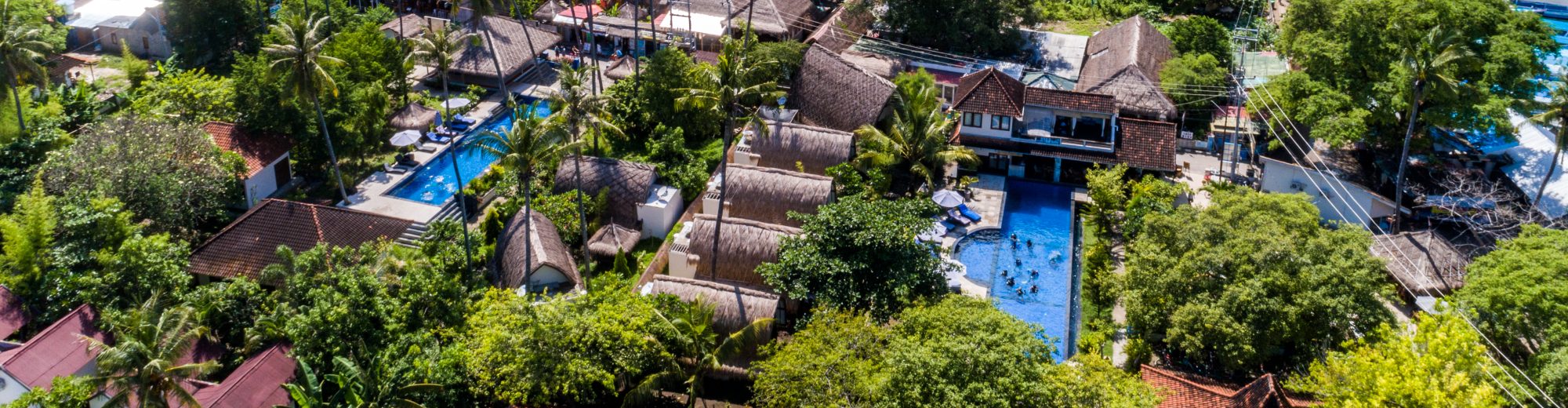
For people who never dived before, there are pools to try scuba diving, like the Oceans 5 pool. A 25 meter pool specially made for scuba diving. It is a perfect place to start your first dive experiences.

Yesterday Oceans 5 dive resort had 21 students in the pool. If you look at the picture you will see there is space for everyone, and that the instructor are teaching only small groups, max 4 persons.

If you like more information about scuba diving around the Gili Islands: info@oceans5dive.com

Turtle release and beach/reef clean up at Oceans 5 dive resort

Oceans 5 dive resort is taking care of their environment. They do with with their weekly beach and reef clean up in the harbor of Gili Air, Gili Islands. But also Oceans 5 has a turtle conservation programme.

Yesterday Oceans 5 did a clean up in the harbor of Gili Air with 6 people. They found a lot of rubbish, in total 6 bags. Plastic bottles, cans, chips bags, wood, stone, glass, etc are the main part of the collected rubbish.

A few hour later Oceans 5 released 25 turtles. They have been for 3 months at Oceans 5 dive resort and they are now big enough to experience the real world. In the beginning they didnt know where to go, but all found their way to the water and dived into it. After a few goodbyes all turtles decided to swimm yo the deep part. Hopefully we see them one day….

Flounders around the Gili Islands

Sometimes if Oceans 5 is diving around the dive site Hans Reef, North of Gili Air, Lombok, the divers come back on the boat and the have seen someting moving in the sand but they dont know what they have seen. Most likely they have seen a Flounder. Flounders are hard to see and specially when you dont expected them, or you dont have a lot of experience.

The flounder is a species of flatfish that is found in the coastal waters of the northern Atlantic and Pacific Oceans. Flounder are found hiding on the ocean floor at depths from shallow coral reefs to the deepest trench on Earth.

There are five different species of flounder found in the oceans, and only one of these flounder species (the Japanese flounder) is found in the Northern Pacific Ocean. The summer flounder, the winter flounder and the southern flounder are all found in the western Atlantic Ocean, while the European flounder is found in the colder waters around Northern Europe.

All five flounder species are very similar in appearance but can vary quite dramatically in size. Flounder can vary from 5 to 25 inches in size depending on the species, but all flounder species have a rounded, flattened body shape with a medium-sized flat tail fin.

The colours and markings of the flounder are dependant on the flounder species, although all five flounder species have adapted to life in the sand on the sea floor and they are often coloured to be camouflaged into their silty surroundings.

Flounder are carnivorous and highly predatory animals. The flounder hides on the sand on the sea floor waiting for potential prey, which the flounder ambushes once it has been spotted. Flounder prey on a variety of bottom-dwelling marine species including small fish, shrimp and crabs.

Due to the secretive nature and good camouflage of the flounder, it rarely spotted by predators. Large fish, sharks, eels, humans, and marine mammals all prey on the flounder when it can be spotted.

Rather than laying her eggs onto an inanimate object or the leaf of a plant, female flounders release them into the water at the time time as the male flounders release their sperm (this form of fertilisation is known as spawning). Once the eggs have been fertilised, the flounder fry begin emerging from them in just a couple of weeks.

New visitor at Oceans 5 dive resort

A day ago Blue marlin trawangan brought a big hawksbill turtle to Oceans 5 dive resort.

The turtle was floating on one of the most famous dive sites of the Gili Islands: Sharkpoint. This turtle couldnt go down, and wouldnt survive if Blue Marlin Trawangan didnt picked it up out of the water.

When the turtle can to Oceans 5 dive resort it has got some medicine, new sea water and food. Its still floating around but eating and swimming.

Hopefully it will recover and will swimm in the blue again.

CAT STERILISATION PROJECT GILI AIR BY GILI ECO TRUST

CAT STERILISATION PROJECT GILI AIR BY GILI ECO TRUST

THE 26th of MAY and 27th of MAY, 2012 FROM 10.00 DR. GEDE, THE VETERINARIAN FROM LOMBOK WILL BE ON GILI AIR TO STERILISE CATS.

PLEASE HELP US AND BRING ALL THE WILD CATS OR CATS THAT ARE YOURS (MALE AND FEMALE) THAT NEED TO BE STERILIZED.
BRING THE CATS IN A STRONG BOX WITH AIR HOLES AND YOUR NAME, PHONE NUMBER AND LOCATION WHERE THE CAT IS FOUND TO OCEANS 5 DIVE RESORT.

IT Is FREE!
SPREAD THE WORD