Tag Archives: beach

Why Do the Gili Islands Have So Many Turtles?

Green Sea Turtle Gili islands | SSI ITC Center Oceans 5 Gili Air

Discover the Secret Behind Indonesia’s Turtle Paradise

If you’ve ever spoken to divers who have visited the Gili Islands, you’ve probably heard the same sentence over and over again:

“I saw turtles on every dive!”

For many divers, seeing a sea turtle is a bucket-list experience. Around the world, divers often need several dives—or even several trips—to encounter one. Yet around Gili Air, Gili Meno, and Gili Trawangan, seeing multiple turtles during a single dive is completely normal.

So what makes the Gili Islands one of the best places in the world to dive with sea turtles?

The answer is a combination of geography, healthy feeding grounds, suitable habitats, conservation efforts, and a little bit of luck. Here is why the Gili Islands have become known as one of Indonesia’s true turtle capitals.


Two Species Call the Gili Islands Home

The two turtle species most commonly encountered around the Gili Islands are:

  • Green Sea Turtle (Chelonia mydas)[1]
  • Hawksbill Turtle (Eretmochelys imbricata)[2]

Both species are listed as Endangered or Critically Endangered in many parts of their range, making every healthy population incredibly valuable.[1][2]

Fortunately, the reefs surrounding the Gili Islands provide exactly what these animals need to thrive.


The Perfect Underwater Restaurant

One of the biggest reasons turtles remain around the Gili Islands is simple:

There is plenty of food.

Green turtles are mainly herbivores as adults. They feed on:

  • Seagrass
  • Marine algae
  • Soft seaweed

The shallow lagoons surrounding the islands contain extensive seagrass meadows that provide an endless buffet.[3]

Hawksbill turtles have a different diet. They specialise in eating:

  • Marine sponges
  • Soft corals
  • Tunicates
  • Small invertebrates

Healthy coral reefs around the Gilis provide exactly these food sources.[4]

With abundant food available year-round, turtles have little reason to migrate elsewhere.


Warm Tropical Water All Year

Sea turtles love warm water.

Around the Gili Islands, sea temperatures generally remain between 27°C and 30°C throughout the year.[5]

These stable temperatures allow turtles to:

  • Feed efficiently
  • Conserve energy
  • Grow throughout the year
  • Avoid seasonal migrations required in colder regions

Unlike destinations where turtles appear only during certain seasons, the Gili Islands offer turtle encounters every month of the year.


Calm, Shallow Reefs

Another major reason turtles thrive here is the reef structure.

Many dive sites consist of:

  • Gentle coral slopes
  • Sandy patches
  • Coral gardens
  • Shallow reef tops

These areas allow turtles to:

  • Rest between feeding sessions
  • Sleep under coral ledges
  • Surface easily for air
  • Feed without fighting strong currents

Some favourite turtle resting locations include:

  • Turtle Heaven
  • Simon’s Reef
  • Hans Reef
  • Meno Wall
  • Halik
  • Shark Point

Many turtles even develop favourite sleeping spots, returning to the same coral bommies night after night.[6]


Plenty of Cleaning Stations

One fascinating behaviour divers regularly witness is turtles visiting cleaning stations.

Small reef fish such as wrasses remove:

  • Algae
  • Dead skin
  • Parasites

The turtle remains almost motionless while the cleaner fish do their work.

This natural “spa treatment” helps keep turtles healthy and is one of the reasons they continue visiting the same reefs repeatedly.[7]


Protection Through Marine Conservation

The Gili Islands are part of the Gili Matra Marine Tourism Park, a protected marine area managed to conserve coral reefs and marine biodiversity.[8]

Over the years, local stakeholders—including dive centres, conservation organisations, government agencies, and the community—have worked together to:

  • Reduce destructive fishing
  • Improve mooring systems
  • Promote reef conservation
  • Remove marine debris
  • Educate visitors
  • Support sustainable tourism

Although challenges remain, these efforts have helped maintain habitat quality for turtles and many other marine species.[8]


Healthy Coral Reefs Support Healthy Turtles

Sea turtles depend on coral reefs far more than many people realise.

Healthy reefs provide:

  • Shelter
  • Food
  • Protection
  • Cleaning stations
  • Navigation landmarks

Although coral bleaching and climate change continue to threaten reefs worldwide, many reefs around the Gili Islands still support high biodiversity compared with many other locations in the region.[9]

Protecting coral reefs also means protecting turtles.


Fewer Natural Predators

Adult sea turtles have relatively few natural predators.

Young hatchlings face dangers from:

  • Birds
  • Crabs
  • Fish
  • Reef sharks

However, once turtles reach adulthood, very few animals are capable of hunting them.

This allows adult turtles to remain on the reefs for decades.

Some green turtles may live well over 70 years.[10]


They Remember Good Feeding Areas

Sea turtles possess remarkable navigation abilities.

Research has shown they can remember productive feeding grounds and return repeatedly over many years.[11]

Many turtles around the Gili Islands appear to have established home ranges around favourite dive sites.

This explains why experienced dive guides often recognise individual turtles by:

  • Shell markings
  • Missing scales
  • Scars
  • Shape of the carapace

Some turtles have been observed on the same reefs for many years.


Responsible Diving Helps

The Gili Islands welcome thousands of divers every year.

Fortunately, responsible dive practices can minimise disturbance to turtles.

Good dive operators encourage divers to:

  • Keep a respectful distance.
  • Never touch or ride turtles.
  • Avoid blocking their path to the surface.
  • Maintain good buoyancy.
  • Never chase turtles for photographs.
  • Avoid using bright flashes directly in their eyes.

These simple actions reduce stress and allow turtles to continue behaving naturally.

At Oceans 5 Gili Air, divers are briefed before every dive on responsible interactions with marine life. Small dive groups—typically a maximum of four certified divers per guide—also help reduce pressure on the reefs and create a calmer experience for both divers and wildlife.


Why Divers Love the Gili Islands

Many dive destinations advertise turtle encounters.

The Gili Islands consistently deliver them.

Whether you are:

  • Trying scuba diving for the first time
  • Completing your Open Water course
  • Joining fun dives
  • Becoming a Divemaster
  • Training as an SSI Instructor

there is a good chance turtles will become one of the highlights of your underwater adventure.

For underwater photographers, turtles provide incredible opportunities to capture graceful images in crystal-clear tropical water.

For children, swimming alongside a turtle often becomes the moment that inspires a lifelong passion for marine conservation.

For experienced divers, watching turtles calmly feed or rest on the reef is a reminder of how healthy marine ecosystems should look.


Every Turtle Encounter Is a Privilege

Although turtles are commonly seen around the Gili Islands, it is important to remember that they remain threatened globally.

Plastic pollution, ghost nets, habitat destruction, climate change, boat strikes, and illegal harvesting continue to impact turtle populations across the world’s oceans.[1][2]

Every turtle seen while diving around the Gili Islands is part of an important conservation success story—but also a reminder that these magnificent animals still need our protection.

By diving responsibly, supporting environmentally conscious dive centres, and respecting marine life, every visitor can help ensure that future generations continue to enjoy unforgettable turtle encounters around this tropical paradise.


Frequently Asked Questions

Why are there so many turtles around the Gili Islands?

The Gili Islands provide ideal conditions for turtles, including warm water, abundant seagrass, healthy coral reefs, plentiful food, cleaning stations, and protected marine habitats. These factors encourage turtles to stay year-round.


Which turtle species can I see?

The two most common species are the Green Sea Turtle and the Hawksbill Turtle.


Can beginners see turtles?

Absolutely. Many beginner dive sites and even some snorkelling locations regularly have turtle sightings, making the Gili Islands one of the best places for first-time underwater encounters.


Is it safe to dive with turtles?

Yes. Sea turtles are peaceful animals and pose no danger to divers. The most important rule is to observe them respectfully without touching or chasing them.


What should I do if I see a turtle while diving?

Stay calm, maintain neutral buoyancy, keep a respectful distance, avoid blocking its path to the surface, and enjoy the encounter without disturbing its natural behaviour.


References

[1] International Union for Conservation of Nature (IUCN). Chelonia mydas (Green Turtle) Red List Assessment.

[2] International Union for Conservation of Nature (IUCN). Eretmochelys imbricata (Hawksbill Turtle) Red List Assessment.

[3] NOAA Fisheries. Green Sea Turtle Biology and Feeding Ecology.

[4] NOAA Fisheries. Hawksbill Sea Turtle Species Guide.

[5] Coral Triangle Initiative. Marine Environment of Indonesia.

[6] Schofield, G. et al. Studies on sea turtle home ranges and resting behaviour.

[7] Bshary, R. Cleaning Mutualisms in Marine Ecosystems.

[8] Indonesian Ministry of Marine Affairs and Fisheries (KKP) & BKKPN Kupang. Management of Gili Matra Marine Tourism Park.

[9] Reef Check Foundation. Coral Reef Health Monitoring and Coral Triangle Reports.

[10] NOAA Fisheries. Sea Turtle Life History.

[11] Lohmann, K. J., Putman, N. F., & colleagues. Sea Turtle Navigation and Long-Distance Orientation.

Your First Scuba Dive

What to Expect at Oceans 5 Gili Air

Turtles Indonesia | Scuba Diving Gili Air | SSI ITC Dive Resort Oceans 5 Gili Air

Have you always wondered what it’s like to breathe underwater? If you’re thinking about trying scuba diving for the first time, you’re probably excited—but maybe a little nervous too. That’s completely normal. Almost every certified diver remembers their very first breath underwater.

At Oceans 5 Gili Air, we have been introducing people to the underwater world for more than 15 years. Thousands of guests have taken their first scuba dive with us, and our goal has always been the same: to make your first diving experience safe, relaxed, and unforgettable.

If you’re wondering what your first scuba diving experience looks like, here’s exactly what you can expect.

Step 1: Register Through the SSI App

Before your first dive, you’ll register for your program through the SSI (Scuba Schools International) app. This gives you access to your digital learning materials and allows us to create your diver profile.

Our instructors will help you through the registration process if needed, so you don’t have to worry if you’ve never used the app before.

Step 2: Learn the Basics of Scuba Diving

Before entering the water, you’ll have a theory session with one of our experienced instructors.

Don’t worry—this isn’t like sitting in a classroom all day. The theory is designed to give you the knowledge you need to enjoy your dive safely and confidently.

During this session, you’ll learn about:

  • How scuba equipment works
  • How to breathe underwater
  • Equalizing your ears
  • Underwater communication using hand signals
  • Basic safety procedures
  • What marine life you may encounter around the Gili Islands

Your instructor will explain everything in a clear and easy-to-understand way, and there is plenty of time to ask questions.

Step 3: Practice in Our Training Pool

Once you’re familiar with the basics, it’s time to get into the water—but not the ocean just yet.

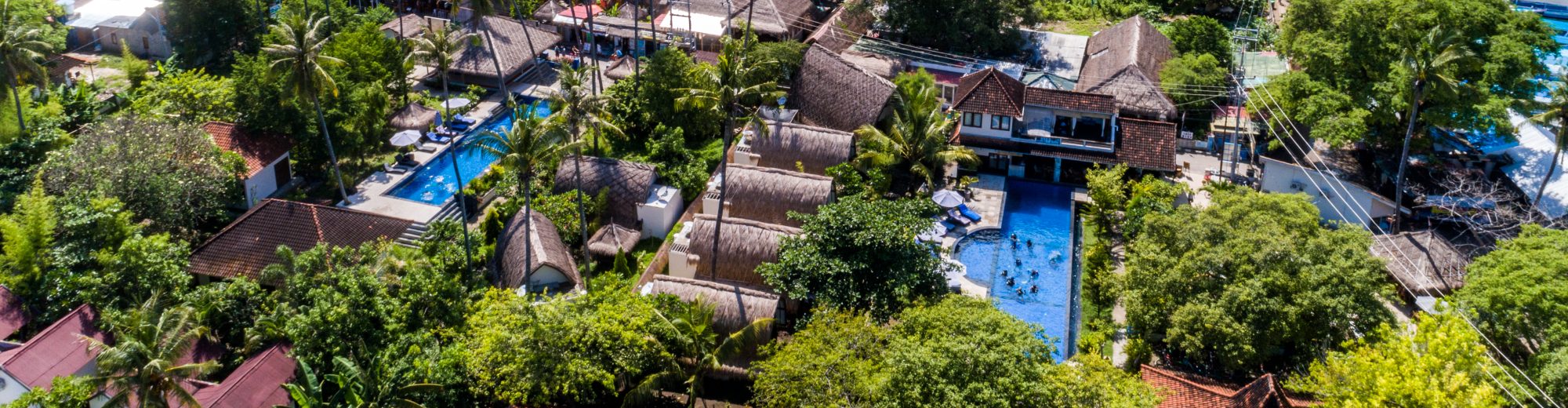
You’ll begin in one of our purpose-built training pools, where you’ll become comfortable with your scuba equipment in a calm and controlled environment.

During the pool session, you’ll practice essential scuba skills, including:

  • Breathing through your regulator
  • Clearing water from your mask
  • Recovering your regulator
  • Equalizing your ears
  • Buoyancy control
  • Swimming comfortably with your equipment

There is absolutely no rush.

Our instructors work at your pace, making sure you’re comfortable before moving on to the next skill. Everyone learns differently, and we believe your first diving experience should be enjoyable—not stressful.

Step 4: Your First Ocean Dive

Once you’ve completed the pool session and both you and your instructor are comfortable, it’s time for the part you’ve been waiting for—your first real scuba dive.

You’ll board one of our dive boats and head to one of the beautiful dive sites around the Gili Islands.

Your instructor will stay with you throughout the entire dive.

Depending on the conditions and your comfort level, you’ll descend to a maximum depth of 12 metres, giving you plenty of time to experience what it’s like to breathe underwater while exploring the vibrant reefs of the Gili Islands.

During your dive, you may encounter:

  • Green sea turtles
  • Colorful reef fish
  • Healthy coral reefs
  • Schools of tropical fish
  • Maybe even a reef shark cruising in the distance

Every dive is different, which makes every underwater adventure unique.

Your Instructor Is With You Every Step of the Way

One of the biggest concerns first-time divers have is whether they’ll be left alone underwater.

The answer is simple: absolutely not.

Your experienced SSI instructor will be with you during every part of the program—from the classroom to the pool and throughout your ocean dive.

They’ll continuously check that you’re comfortable, answer your questions, and make sure you’re enjoying the experience.

Why Choose Oceans 5 Gili Air for Your First Scuba Dive?

Choosing where to do your first scuba dive is just as important as deciding to try diving in the first place.

At Oceans 5 Gili Air, we combine experience, quality, and safety to give you the best possible introduction to scuba diving.

More Than 15 Years of Experience

We’ve been introducing people to scuba diving for over 15 years. During that time, we’ve helped thousands of beginners discover the underwater world.

Our experience allows us to understand exactly how first-time divers feel and how to build confidence step by step.

Experienced SSI Instructors

Our instructors are passionate about teaching and take pride in helping new divers feel relaxed and comfortable.

Whether you’re excited or a little nervous, we’ll guide you through the experience at your own pace.

Well-Maintained Equipment

Quality equipment makes a big difference, especially when it’s your first dive.

At Oceans 5 Gili Air, all of our scuba equipment is carefully maintained and regularly serviced to ensure reliability and comfort.

World-Class Facilities

Our facilities have been designed specifically for diver training.

You’ll enjoy:

  • Large purpose-built training pools
  • Spacious classrooms
  • Comfortable equipment areas
  • Modern rinse and storage facilities
  • Dedicated dive boats

Everything is designed to make your experience smooth from start to finish.

We Teach at Your Pace

One of the things that makes Oceans 5 different is that we never rush our students.

Everyone learns differently. Some people are comfortable immediately, while others need a little more time to build confidence.

That’s perfectly okay.

Our instructors focus on helping you become comfortable underwater, not simply completing the program as quickly as possible.

Start Your Underwater Adventure Today

Your first scuba dive is something you’ll remember for the rest of your life. It’s the moment you discover a completely different world beneath the surface—a world filled with colorful coral reefs, graceful sea turtles, and incredible marine life.

At Oceans 5 Gili Air, we’ll make sure your first experience is safe, relaxed, and enjoyable from beginning to end.

If you’ve ever dreamed of breathing underwater, there’s no better place to start than the crystal-clear waters surrounding the Gili Islands.

Ready to Take Your First Breath Underwater?

Join Oceans 5 Gili Air and discover why we’ve been trusted by beginner divers for more than 15 years. With experienced instructors, world-class facilities, well-maintained equipment, and a teaching style that moves at your pace, we’ll help you take your first step into the incredible world of scuba diving.

The Best Night Dive on Gili Air?

Most Divers Never Discover This Hidden World

The Best Night Dive on Gili Air | Dive Resort Oceans 5 Gili Islands

When people think about diving around Gili Air, they usually imagine turtles, clear blue water, colorful coral reefs, and beautiful daytime dives. But what if we told you that some of the strangest and most fascinating marine life only appears after the sun goes down?

At Oceans 5 Gili Air, we organize night dives every day on request, and many divers tell us afterward that their night dive became the highlight of their entire holiday.

Why Dive at Night?

The ocean completely changes after sunset.

Fish that hide during the day come out to hunt. Octopuses leave their dens. Pipefish move through the darkness searching for food. Crustaceans emerge from the sand. Suddenly, the reef becomes a completely different world.

A night dive is not just another dive. It is like visiting an entirely new dive site.

The Harbor Night Dive: Gili Air’s Best-Kept Secret

Many divers would never guess that one of the most exciting night dives around Gili Air is right in the harbor.

At first glance, the harbor doesn’t look spectacular. Like many harbors around the world, there is debris and man-made structure on the seabed. But this is exactly what attracts an incredible variety of marine life.

The harbor has become a haven for macro creatures and underwater photographers.

During our night dives, it is common to encounter:

  • Various species of pipefish
  • Octopuses hunting across the bottom
  • Crabs and shrimps
  • Juvenile reef fish
  • Fascinating nocturnal creatures rarely seen during the day

Every dive is different, and every torch beam reveals something new.

The Hidden Secret of the Mandarin Fish

Most divers know that mandarin fish are famous for their short mating display at dusk.

What many divers don’t know is that the harbor of Gili Air is one of the hidden secrets for finding mandarin fish.

While other locations require perfect timing and a lot of luck, sightings here are remarkably consistent. In fact, many divers are surprised to discover that mandarin fish can often be seen outside the typical dusk window.

Although nature never gives guarantees, this is probably one of the closest things to a “mandarin fish guarantee” you will find around the Gili Islands.

The Best Night Dive on Gili Air | Dive Resort Oceans 5 Gili Islands

Four Divers or More? We Go to Mentigi!

When four or more divers join the night dive, we load the boat and head to Mentigi.

Forget the postcard coral reefs.

Mentigi is a true muck diving paradise.

The volcanic black sand may not look impressive at first, but hidden in that sand is an extraordinary world of small marine life.

Every square meter can contain something unusual.

Expect to search for:

  • Rare crustaceans
  • Tiny octopuses
  • Pipefish
  • Night-active reef creatures
  • Camouflaged marine life that is almost impossible to spot during the day

For divers who love macro photography and critter hunting, Mentigi is one of the most exciting dive sites around Gili Air.

A Completely Different Diving Experience

Many visitors come to Gili Air for turtles and coral reefs. That’s fantastic.

But night diving shows you a side of the ocean that most tourists never experience.

The darkness sharpens your senses. Every creature feels like a discovery. Every dive becomes an underwater treasure hunt.

It is exciting, peaceful, and unforgettable all at the same time.

Join a Night Dive at Oceans 5 Gili Air

Night dives are available every day on request at Oceans 5 Gili Air. Whether you want to explore the mysterious harbor critters or join a boat trip to Mentigi, our experienced team will guide you safely through one of the most fascinating underwater experiences the Gili Islands have to offer.

The question is not whether you will see something unusual.

The question is: how many strange creatures can you spot before your buddy does?

Book your night dive with Oceans 5 Gili Air and discover why some divers say the best diving starts after dark. 🌙🐙🔦

Gili Island Etiquette

Gili Island Etiquette


No bikinis on the streets

No bikinis on the streets


Why do you want to travel to the Gili Islands in Indonesia? Just like a lot of people you are probably want to discover tropical places and different cultures, open your mind, your heart and have fun. When travelling, it is important to blend in and respect the local populations we are visiting so that we don’t offend anyone and fully live the experience of travelling abroad.

So if you are coming to visit the tropical paradise of the Gili Islands, please note a few local dos and donts to help you have a happy stay:

Behaviour:

– In the local culture, it is very rude to point with the feet, so if you need to show something, use your hands

– When giving or receiving something, when eating or touching use your right hand. The left hand is used for other businesses…

– Remove your shoes when entering a building and wait to be invited to sit if you are a guest.

– Smiling and having fun happen naturally when on holiday. Some situations can sometimes be a little frustrating or tiring. Try and deal with these keeping a smile on, the issue will be resulted much easier. Shouting and screaming are very counterproductive and rarely brings a solution. Just keep smiling!

Dress Codes:

As most of the population on the Gili Islands and being located in Asia and mostly muslim, the dress codes here are very different than in the western world. People are modest and cover their body and sometimes their head. Of course as tourists, we are not expected to dress the same way, but we are expected to be respectful! There are signs around the islands, which keep on being ignored. So please be aware!!

– When walking around the island and in villages, tourists need to wear clothes, shorts and t-shirts are good, bikinis are not. When in doubt, put it on!

– On the beach or on a dive boat, bikini and swimwear are accepted, please do note that being topless or wearing very small and revealing bikinis or G-strings are not. So please cover your bits!

We hope that this blog with help you enjoy your holiday and the tropical paradise to the fullest. Please do get in touch on info@oceans5dive.com for any further information on etiquette or scuba diving at all levels. Happy Holiday!!