Tag Archives: diving gili islands

Facts about the Giant Trevallie

Description

All twenty-five species of trevally have elongated, compressed bodies and deeply forked caudal fins, with long, sickle shaped pectoral fins. The Giant Trevally (also known as the ulua, ronin jack and “GT”) is the most prized of the species by anglers and is identifiable by an ovoid patch of small scales located on the breast ahead of the ventral fins. Coloration for the Giant Trevally can range from silvery-white to almost jet-black.

The Giant Trevally uses its superior swimming abilities and power to hunt and smash baitfish. The Giant Treavally is known for stunning prey with its first strike and then circling back to engulf the wounded and/or disoriented baitfish. They will usually devour the prey quickly with one bite, as competition can be fierce from other members of the pack. As they grow, larger specimens move to deeper water and congregate over coral reefs and other underwater structure. Giant Trevally also venture onto flats, headlands and shallow water to hunt food. Giant Trevallies can be found along the reef edge and points where large pounding swells crash on the reef and rocks stirring up food and creating the ideal environment to hunt.

Pound for pound, these are among the hardest-fighting fish in the sea. The current record comes from a plug cast from shore in Japan. Fishing for trevally is best in hotspots like the Seychelles and the edge of the outside reef at Christmas Island, which is also a world-class bonefishing destination.

Average Length

23 inches – 5 feet

Average Weight

30 – 60 lbs

Habitat

The Giant Trevally ranges from estuaries to coral reefs. Juvenile fish are prevalent in estuaries and river systems.


.

Range

Distribution is widespread. They’re found in the warm tropical waters of the Pacific and Indian Oceans as far south as New South Wales in Australia, east to the Hawaiian Islands, west to the eastern islands of Africa and north to Japan. You will find Giant trevallies on the dive sites around the Gili Islands. Specially Deep Turbo, Halik and Sharkpoint are famous for seeing the trevallies.
. .

Facts about Parrotfish

When you are diving around the Gili Island you will spot them on every dive site. Some people loves them other one say this one of the most ugly fish in the sea. We are talking about the Parrotfish.

This herbivorous fish uses its strong beak-like mouthparts to scrape algae and other plant matter from the surface of the coral. This maintains the health of the reef by keeping algae in check, which could otherwise overwhelm the delicate reef ecosystem.

An unusual feature of parrotfishes is that they are able to change sex, with females becoming fully functional males. In a population, parrotfish start off as either females or males (known as primary males). Females may at some point in their life become male (secondary males). Populations that have these two types of males are called ‘diandrous’, meaning ‘two-males’. A terminal phase male defends a territory and a harem of females. If the male should die, the most dominant female will become the dominant male, her ovaries becoming functional male testes.

The parrotfish occurs in the western Atlantic, from Florida, Bermuda and the Bahamas to Argentina and the Gili Islands Indonesia.

Associated with coral reefs at depths of 3 to 25 metres. At night, parrotfish retreat into crevices. Juveniles tend to occur in mangroves adjacent to the reef. The mangroves act as important nursery areas and provide food-rich and predator free safe-havens for the growing young.

Facts about Sea Snakes

Sea snakes are venomous reptiles that live most or all of their lives in the sea. They’re so adapted to life in the ocean that few species can crawl on land. They swim like eels with their paddle-like tail and laterally compressed body. Like marine mammals, they lack gills and must come to the surface to breathe.

Sea-snakes are cold-blooded reptiles, so they live mostly in warm tropical waters, like the Gili Islands. During the diving around the Gilis you will meet some Sea snakes. Sea snakes are fully adapted to breathe, feed, breed and grow in the sea. For air-breathing animals, sea-snakes are remarkable divers. Some species can dive to 100 metres or more, and remain submerged for up to 80 minutes. This may be partly due to the remarkable ability of some species to absorb part of the oxygen they need through their skins. Their nostrils have valves that close when they are under the water.

Sea snakes inject venom with their bites to subdue and kill prey, which is then grabbed in the jaws and swallowed whole. As with other snakes, the skullbones of sea-snakes are loosely attached and they can dislocate their lower jaws and slide them sideways to allowing them to swallow very large prey. Sea-snakes tend to be fussy eaters. Some only eat catfish, another only eats the eggs of two families of fish. Others dine on eels, fish, prawns, crabs and worms.

Sea snake venom is among the most venomous of all snakes, yet sea snakes rarely inject enough venom to significantly harm a person. In fact, very few human deaths from sea snakes have been reported. They prey mainly on fish and other sea creatures.

Sea snake venom has properties that may one day help in surgeries. Scientists are currently researching whether sea snake venom can be used as an anesthetic.

Female sea snakes sometimes attract attention from more than one suitor and mate in the open water. They give birth to live young at sea. The mother then leaves the young to fend for themselves.

No species of sea snakes are listed as threatened, although the distribution and status of most species is not very well known.

Facts about Barracudas

When you are diving around the Gili Islands you have a chance to see at the divesites Sharkpoint, Hans or Halik the Barracuda. Also in the evenings when you pass all the BBQ places for dinner, the barracuda is one of the most seen dishes. But how does it looks like?

Description

The great barracuda has a slender, streamlined body that is round in the mid-section. The top of the head between the eyes is nearly flat and the mouth is large, containing many large sharp teeth and a projecting lower jaw. The pectoral fin tips extend to the origin of the pelvic fins. The spinous and soft dorsal fins are widely separated and the double emarginate tail fin exhibits pale tips on each lobe. Body coloration of the great barracuda is brownish or bluish gray on the dorsum and upper side, with a greenish cast shading to silvery on the sides and a white belly. The upper side may have 18-23 dark bars most often observable when the fish is resting or over a variegated substrate. The black spots on the lower sides of the great barracuda distinguish it from other species of barracuda. The second dorsal fin, anal, and caudal fins are violet to black with whitish tips. Young barracuda exhibit pale reticulations on the dorsum and a dark stripe on either side that breaks into spots as the fish grows. These patterns are somewhat ephemeral though as juveniles can alter their color patterns to closely match that of their surroundings. These changes in coloration serve to camouflage the fish from predators as well as well as wary prey. Adults have similar coloration along with a more silvery appearance that is advantageous to a fish that swims near the surface of the water.

Habitat

Great barracuda commonly occur in nearshore coral reefs, seagrasses, and mangroves. They may also reside in the open ocean, living predominantly at or near the surface, although they are at times found at depths to 100 meters. Barracudas tend to be solitary but are sometimes found in small aggregations over reefs and sandy bottoms. Juveniles mature amongst mangroves and seagrass beds, habitats that offer cover from predators. During the second year of life, barracuda move to deeper reef habitats. Juveniles and some adults have been observed in areas that receive high amounts of freshwater input, however adults generally tend to avoid areas of brackish water.

Diet

Great barracudas feed on an array of prey including fishes such as jacks, grunts, groupers, snappers, small tunas, mullets, killifishes, herrings, and anchovies. Barracudas have a large gape and very sharp teeth, enabling them to feed on large fishes by chopping them in half. An opportunistic predator, great barracuda feed throughout the water column. Generally a diurnal fish, great barracuda locate their prey largely by sight. The body plan of the great barracuda is designed for speed and it is estimated that top speed for the species may be as fast as 60 km/h.

Fishery

Although not prized as a commercial fish in North American waters, the great barracuda puts up a good fight and is therefore esteemed by some anglers as a gamefish. They may be caught with a variety of gear including handlines, rod and reel, seines, trammel nets, and gill nets. The great barracuda has been implicated in cases of ciguatera poisoning within certain areas of its range. Ciguatera poisoning is caused by the bioaccumulation of ciguatoxins in the flesh of tropical marine fishes. Ciguatoxins are produced by marine dinoflagellates that grow attached to marine algae and as such may be incidentally ingested by herbivorous fishes. Large piscivorous reef dwelling fishes occupying the apex of the food chain become reservoirs for the highest amounts of ciguatoxin by feeding on other members of the reef community. Poisoned people report gastrointestinal maladies that may last several days, a general weakness in their arms and legs, and a reversal in the ability to differentiate hot versus cold. The illness is serious and symptoms may persist for weeks.

Size

Great barracuda are large fish. The record for a hook and line caught great barracuda is 1.7 meters, 44 kg and the species is reported to attain a size of 2 meters, 50 kg. Any barracuda over 4.8 feet (1.5 m) in length can be considered very large. Based on scale analysis of large specimens, great barracuda have a lifespan of at least 14 years. Sexual maturity is reached at a length of about 60 cm.

Range

Occurring worldwide in near shore tropical and subtropical seas (30°N – 30°S), the great barracuda is common in the western Atlantic Ocean from Massachusetts (U.S.) to Brazil. It is also found in the Gulf of Mexico and the Caribbean Sea as well as the eastern Atlantic Ocean, Indo-Pacific, and the Red Sea. It is rare or absent in areas of the eastern Pacific Ocean.

For mor information: http://www.oceans5dive.com
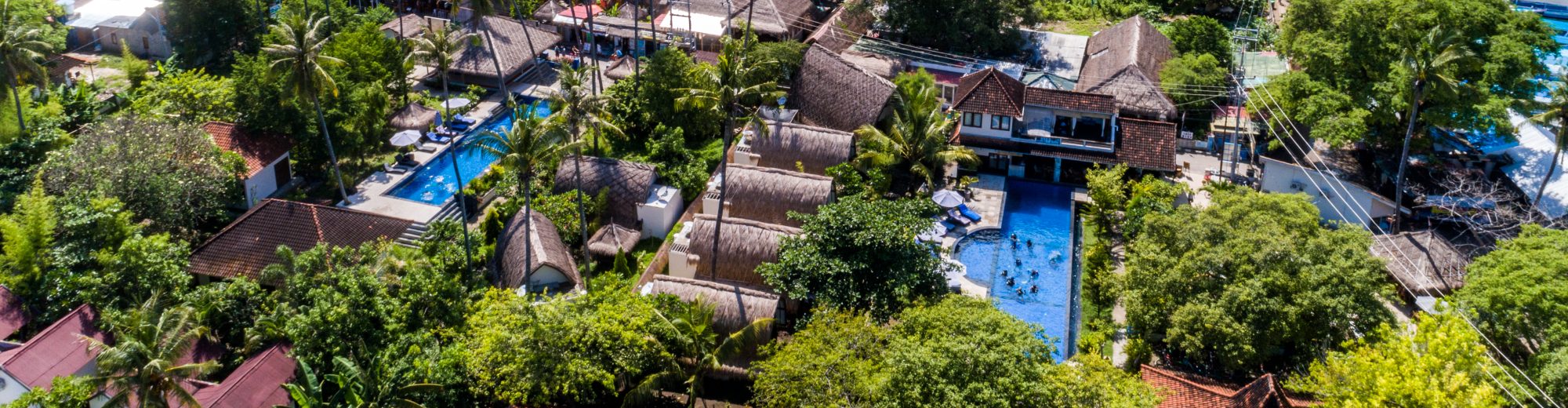
Facts about Damsel fish

The Damselfish are quite lively and colorful and they are common in the tropical seas. They are found in the shallow water of tropical and semitropical seas, like diving around the Gili Islands and at the divesites Halik (North Gili Trawangan), Hans reef (North Gili Air) and Bounty Wreck (South West Gili Meno). They are small and aggressive. They love the coral reefs, mangroves and sea grass. They feed on zooplankton and algae. When they are in courtship, they make purring and clicking noises. The juveniles are different in color than the mature adults. Some juveniles may be red with blue spots. The mature ones are orange-yellow. They can display a ferocious behavior when they feel threatened. Some like to live in open water and swim in schools. These fish are beautiful as the display their bright colors.

Many of the Damselfish grow to a length of 7 cm. They become mature in two to five years. Some species may take much longer to mature. Their spawning season begins in spring and ends in the summer. There are a few different species and some species swim in large schools.

There are about 235 species of Damselfish, and that includes about 26 species of Clownfish. Habitat destruction and the destruction of the coral reefs may soon show declining populations.

The young Blue Damselfish can live together in peace, but they become very aggressive as they mature. They like to stay very close to the coral reef.

The Black and White Damselfish are also called Humbug fish. The Yellowtail Damselfish often lose their beautiful bright colors when they are captured. Some species of Damselfish can only be found in the Caribbean. Some species only live on the bottom of the sea and they defend their territory of about 16 feet. This territory covers feedinmg, spawning and shelter sites. The Damselfish ignores bass and groupers because they are much less competitive. It is the male that prepares for spawning by clearing a surafce of coral or rocky ledge. The female can lay up to about 20,000 oval eggs that are really tiny. The males guards these eggs with his fins. It takes the eggs about three to seven days to hatch.

If you like more information about diving around the Gili Islands visit our website: http//:www.oceans5dive.com

workshop disabled divers Gili Air, Gili Islands

Oceans 5 dive resort is offering workshops for divemaster trainees, divemasters and instructors how to handle disabled divers on land and in the water.

The workshop takes 2 days the participants learn how to handle with blind divers and paraplegic and quadriplegic customers.

In the water they played the role of blind divers and took it in turns to be the guide, having to think in a way that opened up their minds to new techniques such as speaking clearly to customers so they can understand what is happening without sight and tactile teaching. The participants learn to feel how it is to dive without any sight.

Next came scuba diving with paraplegic and quadriplegic customers in terms of equipment configuration, donning of wetsuits, lifting techniques, signs and so on. They learned many new techniques and realized that it is mainly peoples mindsets that limit the possibilities. Specially the bouyancy is an important topic during this part of the workshop. The bouyancy of a paraplegic customer is totally different.

The workshop opends a lot of divers their eyes. They learn to step out the box, and learn to become more flexible.

For further information: info@oceans5dive.com

Diving around Gili Air, Gili Islands, Indonesia

The Gili Islands have to offer all what a diver wants. The combination nightlife and the huge marine diversity is an exception in the world. And that is one of the main reasons why the Gili Islands tracks so many tourist each year.

For a diver there are a lot of things what you can see. For the big stuff Oceans 5 dive resort recommend Shark point, this dive site is on the West side of Gili Trawangan. Shark Point is one of the most famous dive sites around the Gili Islands. Frequent visitors are the white and black tip reef sharks, schooling trevallies, barracuda’s, bump-heads and a lot of turles.

Macro lovers will not be disappointed on the Gilis. The harbor of Gili Air, Oceans 5 house reef is an excellent spot to find all kind of small marine life. In the evenings the reef has the mandarin fish and even the mimic octopus and wonderpus are there. Its a place you will never forget if you find all the different kind of nudi branch and pipefish.

Coral gardens find you at Soraya. This dive site is located between Gili Air and Gili Meno. Here you will find the untouched corals and seafan with pygmy seahorses