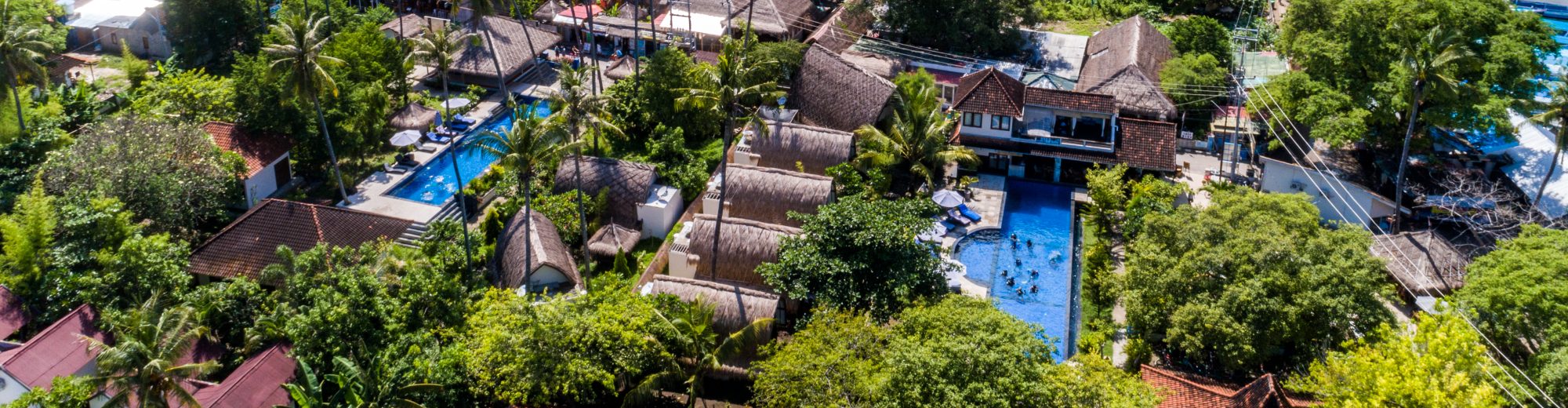

Learning to Dive
If you are planning a scuba diving holiday in the Gili Islands, one of the first questions is often: Where should I stay—Gili Air or Gili Trawangan?
Search online and you will find plenty of dive centers advertising access to around 20 dive sites across the Gili Islands. Technically, that describes the wider diving area. But there is another question worth asking before choosing a dive center:
How many of those dive sites does the dive center actually visit?
That can make a much bigger difference to your diving holiday than which island your hotel happens to be on.
Gili Trawangan, Gili Meno and Gili Air sit within the Gili Matra Marine Tourism Park, a protected marine area managed under Indonesia’s marine conservation framework [1]. Divers are not restricted to the reefs immediately surrounding the island where they are staying.
So perhaps the real question isn’t simply Gili Air vs. Gili Trawangan.
It is:
Which dive center will actually show you the diversity of the Gili Islands?
Around 20 Dive Sites—But Will You Actually Dive Them?
You will regularly see claims online that there are around 20 dive sites around the Gili Islands.
That is a reasonable description when looking at the complete diving area. Based on the dive sites regularly recognized and used within our local diving operations, they can roughly be divided geographically as follows [2]:
- Gili Trawangan: around 6 dive sites
- Gili Meno: around 5 dive sites
- Gili Air: around 4 dive sites
- Between the islands: around 3 dive sites
- Lombok: around 2 dive sites
That gives divers approximately 20 different locations to explore.
However, there is an important difference between having access to 20 dive sites and actually visiting 20 dive sites.
Not every dive center regularly travels throughout the entire area.
If you are doing six, eight or ten dives during your holiday, that difference becomes important. Most divers don’t want to repeatedly visit the same handful of sites simply because they happen to be closest to the dive center.
Gili Trawangan: Sharks, Turtles and Famous Dive Sites

Some of the best-known dive sites in the Gilis are located around Gili Trawangan.
Shark Point is probably one of the first names you will hear. Depending on conditions and luck, divers can encounter reef sharks, turtles and a wide variety of reef life.
Then there is Halik, another popular site offering varied underwater topography and marine life.
Sunset Reef, on the western side of Gili Trawangan, provides yet another type of diving experience.
The waters around the Gili Islands support green and hawksbill turtles, reef fish, sharks and a wide range of other tropical marine species [3].
For many visitors, sharks and turtles are understandably high on their wish list.
Seeing your first reef shark underwater or swimming alongside a turtle can be an unforgettable experience.
But the Gili Islands offer much more than sharks and turtles.
Gili Meno: Turtle Territory

Move across to Gili Meno and the diving changes again.
Two particularly popular sites are Turtle Heaven and Meno Slope.
As the name suggests, Turtle Heaven has become famous among divers for turtle encounters. Green and hawksbill turtles are regularly encountered throughout the Gili Islands, and the reefs around Gili Meno provide important habitat for these animals [3].
Meno Slope combines reef diving with opportunities to encounter turtles and other marine life.
There is also something completely different around Gili Meno.
The Bounty Wreck
The Bounty Wreck is the remains of a former floating platform that sank off Gili Meno. Over time, the structure has become an artificial reef and habitat for marine life.

It provides a completely different diving experience from a traditional coral reef.
For divers who enjoy structures, wrecks and watching how marine organisms colonize artificial surfaces, Bounty Wreck is well worth visiting.
Gili Air: Turtles, Reef Life and Macro
Gili Air adds another dimension to a diving holiday.
Sites such as Hans Reef, Gili Air Wall and Gili Air Harbor can be particularly interesting for divers who enjoy looking for smaller marine life.
Not everyone wants to spend every dive searching for the biggest animal underwater.
Some divers love macro diving.
Instead of constantly looking into the blue for sharks, they look carefully at coral, rubble and sandy areas for the tiny creatures that many other divers swim straight past.
Around Gili Air, patient divers may encounter nudibranchs, pipefish, frogfish, crustaceans and different species of octopus.
The harbor area in particular can provide a completely different experience from the classic turtle-and-reef dives associated with the Gilis.
And that diversity matters.
A great diving holiday doesn’t necessarily mean doing ten dives looking for the same animal.
What About Wreck Diving?
There are also wrecks and artificial structures to explore within the wider Gili diving area.
Around Gili Trawangan you can find Glenn Nusa, while around Gili Meno there is the Bounty Wreck [2].

This means a diving holiday around the Gilis can potentially include:
reef diving, slopes, walls, drift dives, turtle sites, shark encounters, macro diving and wrecks.
But only if your dive operation is willing and able to take you to those different locations.
So Does It Matter Which Gili Island You Stay On?
This is where the Gili Air versus Gili Trawangan discussion becomes interesting.
The three islands are relatively close together.
A diver staying on Gili Air does not have to dive exclusively around Gili Air.
Likewise, someone staying on Gili Trawangan doesn’t technically have to dive only around Gili Trawangan.
The dive sites throughout the marine park can be reached by dive boat.
Therefore, when choosing where to learn to dive or where to spend your diving holiday, the operating philosophy of your dive center can be more important than its island location.
Fuel Prices Can Influence Dive-Site Choices
There is also a practical reality behind running a dive operation.
Boats require fuel.
Travelling from one side of the Gili Islands to another naturally uses more fuel than repeatedly visiting sites close to the dive center.
As fuel and general operating costs increase, there can therefore be a financial incentive for dive operations to concentrate on nearby sites.
That is understandable from a business perspective.
But from the diver’s perspective, it can mean less variety.
A dive center may advertise the diving possibilities of the entire Gili Islands while its regular schedule concentrates on a much smaller selection.
That is why we recommend asking a simple question before booking a multi-day dive package:
“Which dive sites do you actually visit regularly?”
The answer may tell you much more than a map showing 20 different dive sites.
The Oceans 5 Gili Air Philosophy: Dive the Marine Park
At Oceans 5 Gili Air, we look at diving as part of hospitality.
Our guests have often travelled thousands of kilometers to visit Indonesia and the Gili Islands. We want them to experience as much of the underwater environment as reasonably possible rather than simply taking them to whichever dive site requires the shortest boat journey.
That is why our normal daily schedule is designed to explore different parts of the marine park [2].
08:30 – Gili Trawangan Area
Our morning departure can take divers toward the sites around Gili Trawangan.
This gives us opportunities to visit famous locations such as Shark Point, Halik and other sites in the area.
11:30 – Gili Meno Area
Our midday departure can concentrate on the Gili Meno area.
Turtle Heaven, Meno Slope, Bounty Wreck and other sites provide very different diving experiences.
14:30 – Gili Air or Lombok Area
Our afternoon dive generally gives us the opportunity to explore sites closer to Gili Air or selected sites toward Lombok.
That means someone doing several dives with Oceans 5 can potentially experience very different parts of the Gili diving area.
We don’t want to advertise approximately 20 dive sites and then repeatedly visit only four or five.
We want our divers to experience the whole area.
Nature Makes the Final Decision
There is one very important qualification.
We can make schedules.
The ocean doesn’t read them.
Currents are an important characteristic of diving around the Gili Islands. Conditions can change depending on tides, weather, wind and other environmental factors. Responsible dive planning therefore requires adapting the dive to the actual conditions and to the abilities of the divers [4].
At Oceans 5, our site selection considers factors including:
- Current
- Wind
- Waves
- Diver experience
- Certification level
- Recent diving experience
- The interests of our divers
We normally publish the following day’s diving schedule one day in advance.
But that schedule is never more important than the actual conditions.
If nature tells us that another site is the safer or better option, we change the schedule.
That isn’t poor planning.
That is responsible dive planning.
You Can Request a Dive Site
There is another advantage to operating across a wide selection of sites.
You can talk to us.
If you have already been diving for several days and there is a particular dive site you would like to visit, tell the Oceans 5 team.
Maybe you want to search for sharks.
Maybe you haven’t seen enough turtles yet—which can be difficult to imagine around the Gilis!
Maybe you love macro photography and would rather spend an hour searching for tiny creatures than looking for another turtle.
Maybe you want to visit a wreck.
Or perhaps there is simply one dive site on your wish list that you haven’t visited yet.
If conditions, diver experience, certification level and logistics allow it, we can consider your request when creating the schedule.
That is part of hospitality.
What About Learning to Dive?
For beginner divers, this variety can be particularly valuable.
Learning scuba diving isn’t simply about completing a list of skills and receiving a certification card.
You are learning to become a diver.
A modern entry-level scuba course teaches essential knowledge, equipment use, underwater skills, buoyancy control and safe diving practices before certification [5].
But experience also matters.
Different dive sites can introduce a new diver to different situations:
- Changing currents
- Different bottom compositions
- Slopes
- Reefs
- Different depths
- Different marine life
- Different underwater orientations
At Oceans 5 Gili Air, our teaching philosophy focuses strongly on neutral buoyancy and realistic diving techniques[2].
We don’t want students to learn skills in ways that only work during their course.
We want them to develop the buoyancy, awareness and confidence they need when they become independent certified divers.
Experiencing different underwater environments can be part of that development.
Gili Air or Gili Trawangan: Which Is Better?
So which island wins?
There isn’t one answer for everybody.
For nightlife, bars, restaurants and a larger tourism scene, many travellers may prefer Gili Trawangan.
For travellers looking for a somewhat different island atmosphere while still having access to diving throughout the marine park, Gili Air can be an excellent base.
But from a purely diving perspective, we think there is a more important question.
Don’t ask only which island has the best dive sites.
Ask:
“Will my dive center actually take me to them?”
The best dive center for your holiday isn’t necessarily the one closest to Shark Point, Turtle Heaven or Hans Reef.
It is a dive center willing to look at conditions, listen to its divers and explore the wider marine park whenever conditions allow.
One Marine Park, Many Different Dives
Gili Trawangan gives us famous shark and turtle sites.
Gili Meno gives us excellent turtle diving, slopes and the Bounty Wreck.
Gili Air offers reefs, walls, turtles and fascinating macro opportunities.
The areas between the islands and toward Lombok add even more possibilities.
Together, they create the diving destination people know as the Gili Islands.
At Oceans 5 Gili Air, that is how we believe the area should be experienced.
Not one island.
Not four dive sites.
The whole marine park.
Because when someone travels halfway around the world for a diving holiday, our job isn’t simply to put them underwater.
Our job is to show them what the Gili Islands have to offer.
Frequently Asked Questions
Is Gili Air or Gili Trawangan better for beginner divers?
Both islands provide access to suitable dive sites, so the quality of the dive center and instructor can be more important than the island itself. Beginners should look for small groups, experienced instructors, good training facilities and a dive center that selects sites according to conditions and student ability.
At Oceans 5 Gili Air, beginner training focuses strongly on neutral buoyancy and preparing students for realistic open-water diving rather than simply completing the required skills [2].
Can I dive around Gili Trawangan if I stay on Gili Air?
Yes. Staying on Gili Air doesn’t mean you can only dive around Gili Air. Oceans 5 regularly schedules dives around Gili Trawangan, Gili Meno, Gili Air and selected sites toward Lombok, depending on conditions [2].
How many dive sites are there around the Gili Islands?
Around 20 sites are commonly associated with the wider Gili diving area. Oceans 5 roughly divides these into six around Gili Trawangan, five around Gili Meno, four around Gili Air, three between the islands and two toward Lombok [2]. Names and exact classifications can vary between dive operators.
Where is the best place to see turtles?
Turtles can be encountered throughout the Gili Islands, but Turtle Heaven and Meno Slope around Gili Meno are particularly well known for turtle encounters. Green and hawksbill turtles are among the species regularly encountered in the area [3].
Where is the best place to see sharks?
Shark Point around Gili Trawangan is one of the best-known Gili dive sites for the possibility of seeing reef sharks. However, sharks are wild animals, so sightings can never be guaranteed.
Is there macro diving around the Gili Islands?
Yes. The Gilis aren’t only about turtles and sharks. Sites around Gili Air can provide opportunities to search for smaller marine life, including nudibranchs, pipefish, frogfish, crustaceans and octopus. Macro enthusiasts should tell the dive center what they are interested in seeing so guides can take those interests into account.
Are there wreck dives around the Gili Islands?
Yes. Two examples are the Bounty Wreck near Gili Meno and Glenn Nusa around Gili Trawangan [2]. Whether a particular wreck is appropriate depends on conditions, depth and the diver’s certification and experience.
Can I request a specific dive site at Oceans 5 Gili Air?
Yes. Divers are welcome to request particular sites. We cannot guarantee every request because currents, wind, waves, diver experience and logistics must always be considered, but requests are taken into account when planning the schedule [2].
Does Oceans 5 publish its dive schedule?
Yes. Oceans 5 normally publishes the next day’s schedule one day in advance. However, the schedule can change if ocean or weather conditions make another dive site more appropriate [2].
Why doesn’t Oceans 5 guarantee a particular dive site?
Because safety and conditions come first. Currents, waves and wind can change. A dive site that looks perfect when the schedule is prepared may not be the best choice when the boat arrives. Responsible diving means adapting the plan to the actual conditions [4].
Can beginners experience different dive sites during an Open Water course?
Yes, when conditions and course logistics allow. Different underwater environments can help students gain experience while applying the buoyancy, awareness and diving skills learned during their training. The instructor will always select sites appropriate for the student’s level and the conditions [5].
What should I ask a dive center before booking a Gili Islands diving holiday?
Don’t ask only, “How many dive sites are there?”
Ask:
“Which dive sites do you actually visit regularly?”
If you are planning multiple days of diving, also ask whether the center visits sites around all three islands, whether you can request particular sites and how they decide the daily schedule.
References
[1] Ministry of Marine Affairs and Fisheries / BKKPN Kupang – Official information and management framework relating to the Gili Matra Marine Tourism Park and marine conservation areas in Indonesia.
[2] Oceans 5 Gili Air – Operational dive-site knowledge, daily boat scheduling, site distribution, diver-request policy, local diving experience and Oceans 5 training philosophy.
[3] IUCN Red List of Threatened Species – Species information for green turtles (Chelonia mydas) and hawksbill turtles (Eretmochelys imbricata), including habitat, distribution and conservation status.
[4] Divers Alert Network (DAN) – General diving safety guidance concerning environmental conditions, currents, dive planning and matching dives to diver experience.
[5] Scuba Schools International (SSI) – Open Water Diver training standards and educational framework covering entry-level scuba knowledge, skills, buoyancy, equipment and safe diving practices.


